顯示包含「白銀儲備」標籤的文章。顯示所有文章

2015年1月12日星期一

2014年8月5日星期二

因大單交割所致 上期所白銀儲備跌至148噸歷史最低

數據顯示,上海期貨交易所(SHFE)的白銀儲備繼續在下跌,7月已經跌到了歷史新低148噸。在7月1日,SHFE的倉庫中總共存有234噸白銀,然而,7月初和7月末,曾經出現過大量的白銀交割。
 
  7月第一周結束時,白銀存量從234噸下降到204噸,而到7月18日時,當月的凈交割量為12噸。

  
在7月最後兩周中,SHFE的白銀交割量大幅增加,7月25日結束當周共有23噸白銀被交割,7月最後一周的交割量為21噸。而在7月31日,單日內的交割量就達到了15噸,幾乎是當時庫存量的10%。

  在SHFE的庫存白銀出於頂峰狀態時,即2013年3月,庫存有白銀1143噸。此後其白銀存量就一直在減少,到當年8月,存量大幅減少了610噸至僅僅533噸,降幅達53%。到11月存量降至418噸後,下降速度開始有所減緩。

  在此後3個月中,SHFE的白銀庫存一度在2月達到575噸,在此期間,SHFE的白銀庫存和銀價同步增加。

  而後,隨著銀價修正,3月白銀庫存下降到417噸,隨後到4月末僅僅只有246噸。在5月6月間,白銀庫存量比較平穩,而6月現貨白銀價格有所增加。

  從6月到7月,銀價和白銀存量再度同步減少,7月存量下降了86噸,目前降至歷史最低的148噸。

  也就是說,從2013年3月至今,SHFE的白銀庫存量減少了將近90%。

2014年7月12日星期六

Mexico Looks To Back Peso With Silver: “Would Unleash a Global Power Shift”

New silver-backed currency in Mexico or any other country could be a boon for precious metals
Mexico Looks To Back Peso With Silver: “Would Unleash a Global Power Shift”
by Mac Slavo | SHTFplan | July 11, 2014


Watch at Future Money Trends)
This could be a major turn of events that will have global implications. The action’s set to unfold in Mexico, where many of its most influential and wealthy citizens are demanding the country abandon its fiat currency, the Peso, and return to a silver standard. … We know that many people are used to looking at Mexico as the violent, crooked, messed up country over the border… the one that sends all those illegals over here because even picking canteloupes for giant U.S. agri-businesses pays better than the job at home… it’s now time to rethink all that, because a silver standard in Mexico would unleash the biggest global power shift since Spain raided the Aztecs 600 years ago. It’s unavoidable. History repeats itself, especially when its exactly the same economic situation.
Coupled with a continued silver supply crunch and deteriorating conditions for fiat currencies around the globe, a new silver-backed currency in Mexico or any other country could be a boon for precious metals.
The real question is, will western central bankers allow such a move to happen? We know what happened in Libya and Iraq when their leaders tried a similar strategy that would have freed them from their dependence on U.S. dollars. They ended up under a no-fly zone that carpeted their countries with millions of pounds of ordnance.
But with Mexico working closely with China on economic matters and numerous super powers vying for control of the global economy and geo-political landscape, new systems of trade are sure to emerge. Those who catch the trends early and invest appropriately in hard assets could see their personal wealth increase significantly during the financial, economic and monetary upheaval to come.

2014年2月21日星期五

泛美白銀:白銀預​​計儲量達三億兩千五百萬盎司

泛美白銀公司於2013年開展的大規模礦山探測項目結果非同尋常,根據最新數據顯示,泛美白銀公司白銀預計儲量已達三億兩千五百萬盎司。

2013年整年,泛美白銀公司在礦山探測方面投入將近1630萬美元,鑽探距離將近150千米。通過大量的探測,泛美白銀公司探測到四千萬盎司可靠的銀礦資源,而這一數據高於去年的生產量,三千三百七十萬盎司。

其中,LaColorada礦山於2013年再次探測到了出色的礦藏結果。去年該礦山探測到一千六百六十萬盎司白銀,總礦藏量為八千一百四十萬盎司。同比增長26%。該礦山現在為泛美白銀公司最大的銀礦。

此外,Huaron,Morococha和SanVicente地區的礦山也同樣探索結果喜人。 Huaron礦山現白銀礦藏量為六千二百三十萬盎司,於泛美白銀公司排名第三。 Morococha和SanVicente銀礦礦藏量分別為三千四百三十萬盎司和三千七百五十萬盎司。

2013年7月29日星期一

新加坡銀庫開張迎接亞洲富人需求


儘管白銀價格進入2013年以來遭遇重挫,但為滿足亞洲富人對貴金屬的實物需求,新加坡近期建立了一個能夠容納200噸白銀的銀庫。

Malca-Amit公司是這家銀庫的所有者,該公司的總經理Joshua Rotbart在接受彭博社採訪時稱:

    該銀庫在開張時就已經有30%被預定。以市價來計算,該倉庫能容納價值1.28億美元的白銀,黃金價值則是67倍。該公司在新加坡自由港有5座地下倉庫,這5座倉庫已經全部被黃金藏家預定。

法國凱捷公司和加拿大皇家銀行的數據顯示,亞太地區的高淨值人群在2012年擴張了9.4%。其中,一億美元可投資資產以上的富人升至368萬人,這主要是受到了新加坡和香港富人增加影響。

Rotbart並未透露該倉庫的位置,但他表示:

目前我們在新加坡已有的地下倉庫都處於高度安全的狀態,其費用對於儲藏白銀來說是非常昂貴的,但我們看到了(銀庫市場)存在著強勁的需求,因此我們需要找到一個解決方法。

Rotbart還稱:

    白銀投資者多為私人投資者,而黃金的持有者多數則為機構。 Malca-Amit目前正尋求在香港新建立一個銀庫。此外,鑑於自由港的空間已經沒有,其可能在新加坡自由港再增加一個金庫。

瑞銀的一位高管在月初時曾表示,該銀行已經通過租賃倉設備的方式向客戶提供黃金儲藏服務。摩根大通也在2010年時於新加坡自由港開立了一個金庫。

德意志銀行駐新加坡發言人Jeremy Hughes表示,該銀行已經將其在Malca-Amit的100噸金庫租借出去。

Malca-Amit公司主要是向銀行和自己的客戶租借倉庫。其在香港和新加坡各有一個可以儲藏1000噸貴金屬的金庫。此外,其在紐約、蘇黎世、日內瓦、倫敦和曼谷都有儲藏設施。

新加坡政府也一直在推動該國黃金交易中心的建設,其在2012年取消了對投資級貴金屬的7%的銷售稅。目前全球有2%的黃金需求通過新加坡得到滿足,該國政府的目標是將這一比例提升至15%。


http://wallstreetcn.com

2013年4月11日星期四

中國囤積大量白銀 白銀下跌空間仍舊很大


如果看看中國自2010年以來的白銀進口量就知道為什麼庫存會如此之多了。早在2007年時,中國還是個白銀淨出口國,後來由於出口退稅和國內需求的增長,從2010年開始,中國變成了白銀的淨進口國。
當年,中國月均進口298噸白銀,同時,中國每月還從採礦和回收廢舊金屬中獲得288噸白銀,也就是總的月均供給量有586噸。而2010年時,來自製造業的白銀消費需求月均只有330噸,說明每月供給過剩256噸
後來,中國的月均進口量從2010年的298噸下降到了去年的166噸,但這種下滑不足以遏制中國國內白銀囤積量的增加。
那麼,要想改善基本面,可能的途徑就只有以下兩個:
第一,中國白銀的製造業需求和投資需求增長速度必須快於庫存增長速度;第二,中國必須重新成為白銀的淨出口國。
但就後者而言,即便真是那樣,那也不過就意味著,白銀從一個地方被轉移到另一個地方,而不是消耗掉了,對銀價而言,其結果最好也只是中性而已
所以,我們相信,只有前者才能有效降低白銀的庫存並為其建立起一個可持續的牛市基礎。然而我們估算,中國白銀去年庫存量仍是在增加的,其結果就是,去年多數時候,銀價都在半死不活地掙扎著。
從長期價值來看,白銀每盎司只值20美元,因此對比其他大多數金屬而言,白銀的價格無疑是偏離價值最多的品種。當然,這並不是說,白銀會在短期內就迅速回歸其價值中樞,因此相對其生產成本而言,白銀的下跌空間還很大。如果後市需求下降,即便只是暫時的,白銀也會去測試更低的位置。再結合白銀高庫存的基本面判斷,我們認為,當銀價接近31美元/盎司之時,投資者應當做空。
而觸及31美元是有可能的,因為目前黃金徘徊在1600美元附近,而我們依然看漲黃金,所以白銀也有機會跟隨攀升至31美元以上。
整個3月份,上海期交所的白銀期貨升水幅度都非常有限,這預示著中國對白銀的需求疲弱。
從交易的角度看,我們估計白銀的重要支撐位是28.5美元,一旦跌破,就將奔26美元的區間而去,現在正是如此。


Original Source 

2013年3月16日星期六

Discovery - 銀礦的開採

彼得林區說過這麼一段話:「要區分投資和賭博並不是看您從事何項活動(例如:創業、買股票、賭馬),而是要看您對這項活動所牽涉的技巧了解的程度以及參與的企圖心。賭馬老手堅持自己的一套下注原則,靠賭馬取得一份相當穩定的長期報酬,對他來說這就像投資績優股一樣可靠。而有些魯莽衝動的投資人成天追逐熱門股、聽信名牌、殺進殺出,這種『投資』方式跟在跑馬場上隨便挑隻鬃毛最漂亮的馬就胡亂下注沒什麼兩樣」。

對自己所參與的活動一定要有深入的了解,才是不至於踏上賭博一途的最佳方式。


2013年3月12日星期二

Silver - Visualized in Bullion Bars


http://demonocracy.info/infographics/world/silver/silver.html


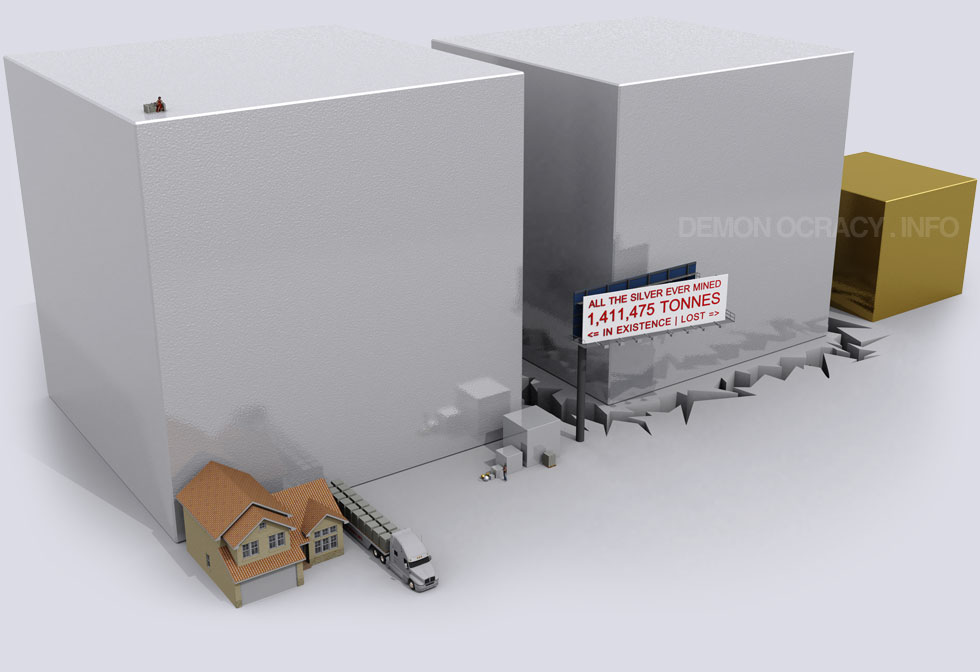
This infographic shows all the Silver ever mined throughout history.
Silver price is currently hovering around $30 / troy oz.
When Silver price hits $31.10 / troy oz each gram of Silver will be exactly $1.
Silver is usually measured in Troy Ounces. A Troy Ounce is about 1.09 regular Ounces.
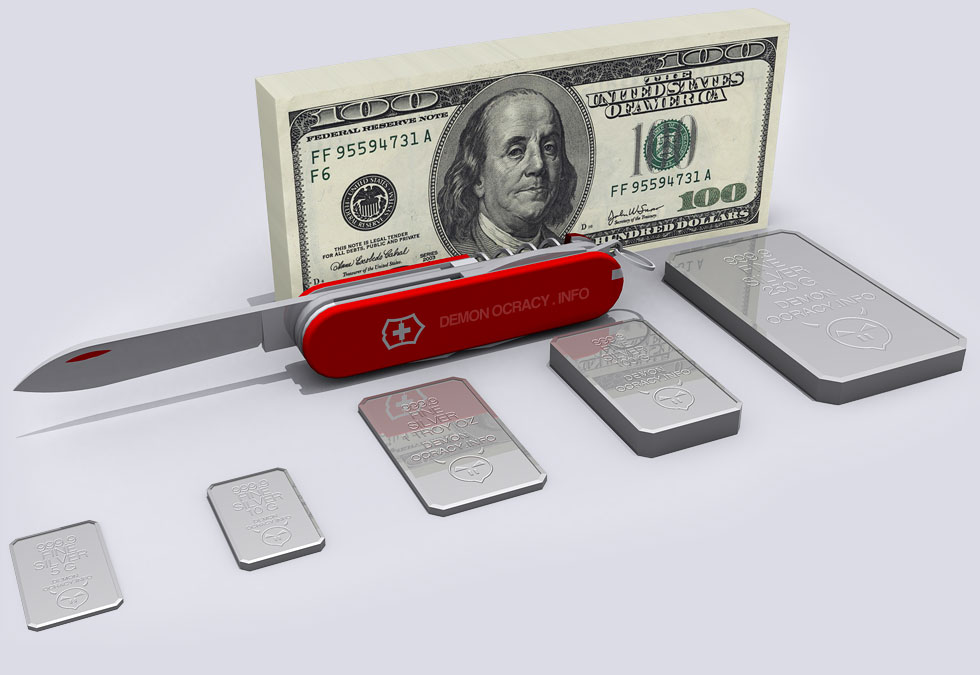
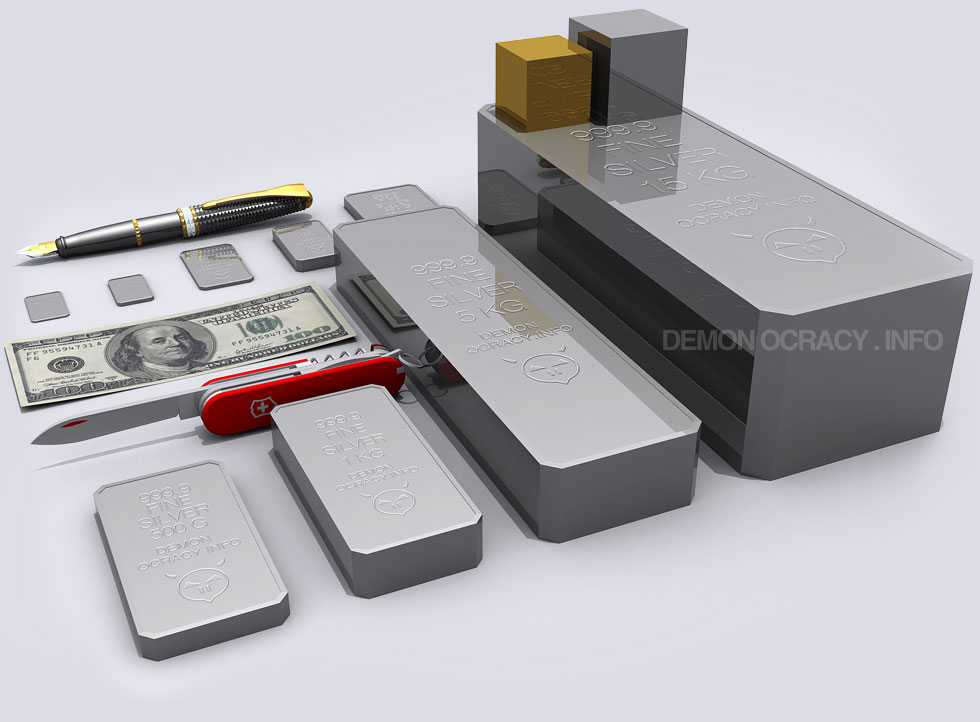
Silver – Size Chart
This is a chart of standard Silver bullion size comparison.
The silver bars are measured by Silver volume & weight of
10.49 g/cm−3 in typical Silver Bar Dimensions.


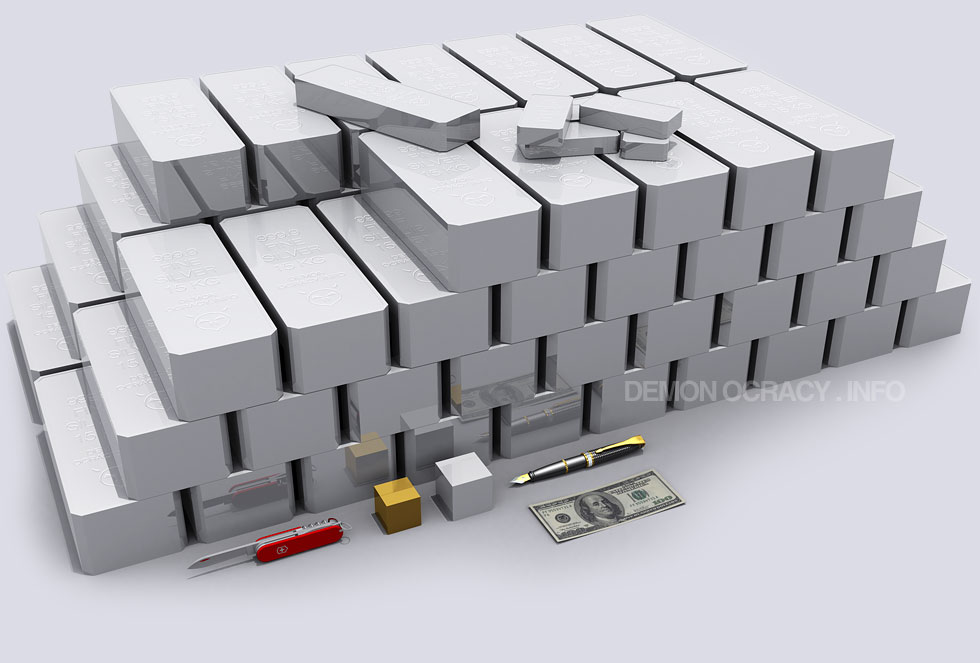
1 Ton of Silver = $1 Million @ $31.10 / Troy oz
Silver price is hovering around $30/ troy oz, once Silver hits $31.10 / troy oz, Silver will cost exactly $1/gram,
at that point the 1 Ton of Silver displayed above will be worth exactly $1 Million DollarsSilver is not purposely mined, 80% of new Silver production is a by-product of Gold or Copper mining, this is due to Silver’s recent low value compared to other metals.
Silver has the best electrical conductivity of any element and highest thermal conductivity of any metal.
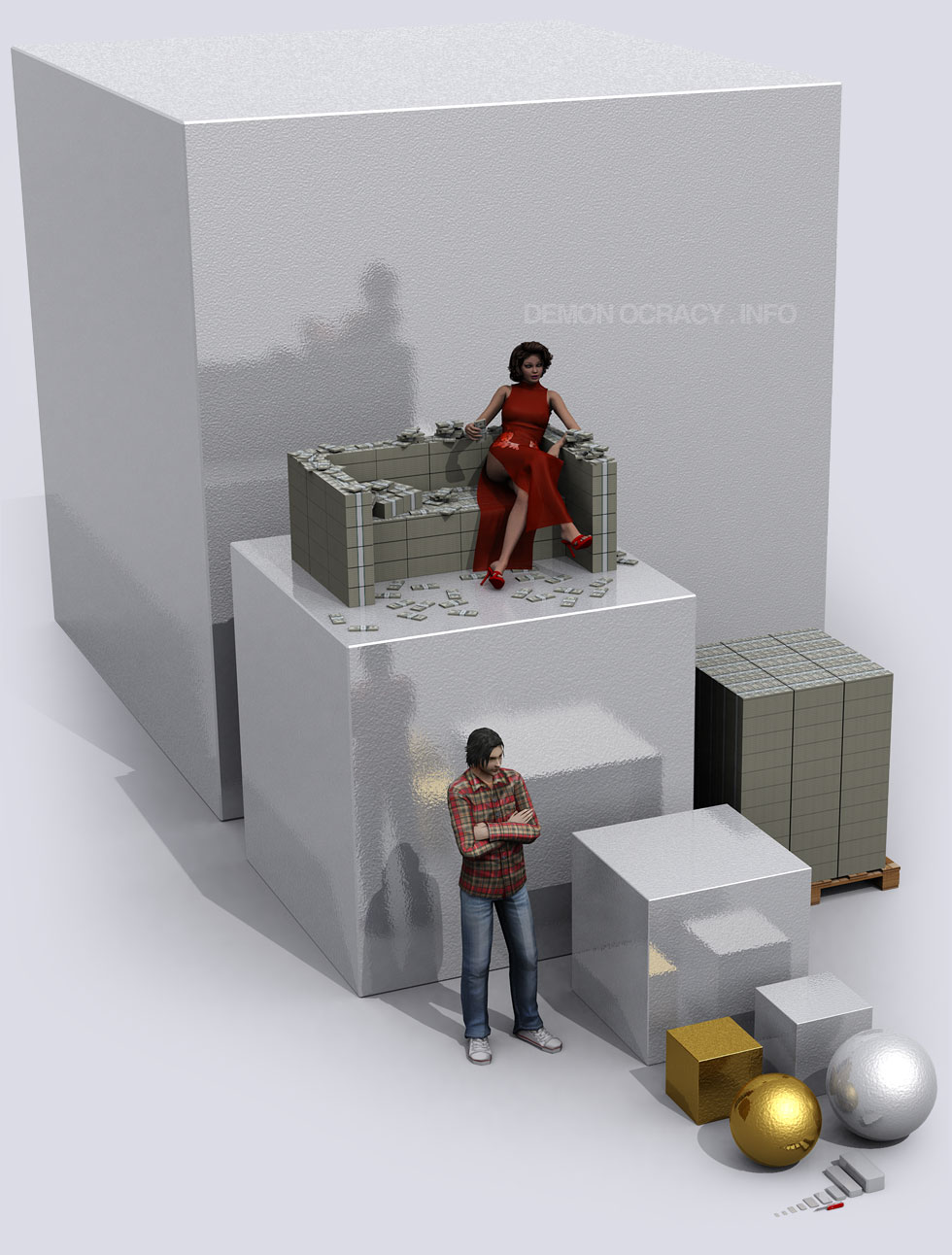


1 Ton of Silver
10 Tonnes of Silver
100 Tonnes of Silver
1000 Tonnes of Silver
The 1 ton of silver is worth $1 million dollars at $31.10 / troy oz.
While there are significant Silver reserves underground, due to the low prices they are not being mined. Silver has run a 63 year long supply/demand deficit as of year-end 2004, this is mainly
due to Silver getting lost and industrial production demand, including x-rays, photography, mirrors, electrical and electronic products.
This amounts to a deficit of 331.46 Tonnes since 1942. Source


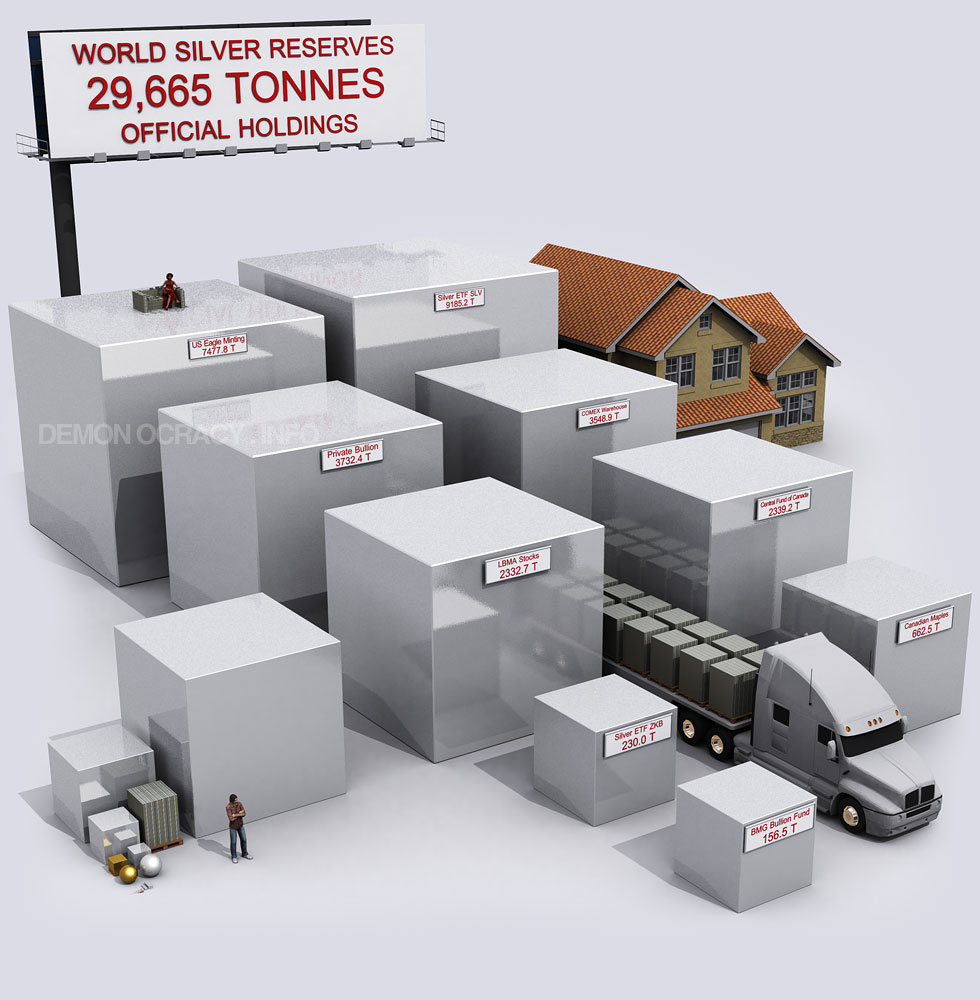
BMG Bullion Fund
Silver ETF ZKB
Canadian Maples Minted
LBMA Estimated stocks
Central Fund of Canada
Estimated Private Bullion
COMEX Warehouses
US Eagles Minted
Silver ETF SLV 156.5 Tonnes
230.0 Tonnes
662.5 Tonnes
2332.7 Tonnes
2339.2 Tonnes
3732.4 Tonnes
3548.9 Tonnes
7477.8 Tonnes
9185.2 Tonnes


All Silver Mined in History – 1,411,475 T
The historical cumulative Gold to Silver production ratio is 1:10.7. Source
The price ratio of Silver to Gold is currently around 1:50.

A thorough analysis of world Silver supply and demand, and the source of the data above can be found here: Article 1, Article 2, Article 3


2013年3月3日星期日

圖解全球白銀

Demonocracy底部圖表告訴我們,

人類鑄造生產白銀合計141.1475萬公噸,黃金16.65萬公噸,

史上白銀與黃金產量比例約為8.477:1,

而白銀與黃金目前的價格比為1:50。

 不過,白銀歷史上流失了63.4199萬公噸,目前有77.7275萬公噸。

 
各國政府白銀儲備合計2.9665萬公噸,


白銀ETF SLV持有白銀9185.2公噸,

紐約商品交易所(Comex)倉庫存有3548.9公噸。

美國鑄造鷹幣使用白銀7477.8公噸,


預計私人持有銀條3732.4公噸。
 
                                     以下點擊看原圖。


2013年2月4日星期一

Global Silver Mining Trends- A Comprehensive Analysis of World Silver Production Since 2001

Submitted by Adam Hamilton, Zeal

A MUST READ analysis of global silver mining production since 2001 over the world’s top silver producing nations.

Over the course of silver’s secular bull, the miners have steadily increased production in order to meet fast-growing demand.  And in 2012 while US production declined, global silver mine production exceeded 24k metric tons (770m+ ounces), an all-time production high and 28% increase over 2001.  As an investor interested in silver’s structural fundamentals, this rapid growth begs a question.  Where in the world is this silver coming from?

In our modern information age we can ask questions like this and easily find the answer.  And we need look no farther than the data provided by the U.S. Geological Survey.  The USGS is a global authority in collecting, analyzing, and disseminating information on both domestic and international mineral supply and demand.  And for silver it dutifully provides annual detailed country-level mine production data.

My preferred way to distill data like this is visually, via crafting a custom chart to paint a clear picture.  And in the chart below I plot the bull-to-date global silver-mining trends for the world’s top dozen silver producers using the USGS’s initial 2012 estimates that were released just this week.

Zeal020113A

With production volume scattered across such a wide spectrum, I indexed each country’s output at 100 beginning in 2001 (the first year of silver’s secular bull).  If a country is at 125, its silver mine production is up 25%.  And inversely if it’s at 75, it is down 25%.  Indexing ultimately allows us to easily compare the production trends of the top producers on a single chart.

Also included in this chart is the raw production data of the world’s top silver miners.  And it is important to note that these 12 countries are responsible for the lion’s share of mined supply, their combined total accounting for 90% (21.4k mt).  Interestingly #12 Canada produces nearly twice as much as the next closest country.  In fact, only 5 countries outside the top dozen actually produce greater than 100 mt of silver annually.

Starting at the top, you’ll notice that silver mine production is dominated by three countries.  And Mexico, China, and Peru have long been the three-headed monster of the silver market.  Back when silver’s bull began in 2001 these three countries were the leaders, accounting for about one-third of the global mined supply.  And as a result of strong growth from each over the last decade, they remain the leaders while accounting for now nearly half of the mined supply.

Mexico comfortably sits atop the silver-mining world.  This country is host to massive silver belts, including the illustrious Sierra Madre belt that flanks the Sierra Madre Occidental mountain range.  Silver has long been one of Mexico’s major exports, dating as far back as the 16th century when the Spanish colonials shipped it back to their homeland via large galleons.

It is believed that about one-third of all silver mined in the history of the world has come from Mexico.  But even with such rich history, this country’s silver mineralization is nowhere near depleted.  The miners continue to make big discoveries.  And these discoveries have great economics as seen by 50%+ production growth over the last decade.

Mexico’s prominence is also apparent in its continued attractiveness to the juniors.  In my latest round of research focused on junior silver explorers, I found Mexico to be the top destination for these companies.  With Mexico’s plush geology and friendly mining laws, about half of all silver juniors own a project in Mexico.

In the #2 spot we find China.  And per the USGS’s latest update to 2011’s numbers that increased Chinese production and lowered Peruvian production, it turns out that 2012 was China’s second year in a row as runner up to Mexico.  This is quite notable, as China had never before cracked the top two.  With Mexico and Peru holding the top-two spots from 1999 to 2010, this is certainly a big shuffle at the top.  China is no longer the third wheel!

China’s journey to #2 is the result of massive production growth, mainly via byproduct production from primary base-metals mines.  Over the last 11 years its silver production has doubled, with the addition of 1.9k mt (61m ounces) to its annual output.  By volume this growth is unmatched by any other country.  And China’s silver production is expected to continue to rise, eventually giving Mexico a run for its money.

Rounding out the big three is Peru, where most of its silver is found high in the Andes Mountains.  And Peru is certainly no slouch considering it had a recent stint as the world’s #1 silver producer, edging out Mexico from 2002 to 2009.  Silver has long been engrained in Peru’s culture.  In fact, the ancient Incans were so enthralled by this soft-white metal that they referred to it as the “tears of the moon”.

Peru’s production is up 34% since 2001.  And though its output has trended down a bit over the last few years, the mining companies have had great success renewing their reserves and making new discoveries.  With the world’s largest reserve base (120k mt), by far, Peru is highly likely to revisit its 2009 all-time production high in the near future.

Next up is Australia.  And as you can see by its production trend, this country has been quite consistent over the last decade or so.  Interestingly over half of Australia’s output comes from a single mine.  And this massive Cannington mine owned by BHP Billiton ranks as the largest silver and lead mine in the world.

Russia has been one of the top performers by percentage growth over the course of silver’s bull.  And considering this country’s huge geographical and geological potential, it sure ought to be among the top producers.  Attributing to Russia’s nearly 300% bump in production is the restart of the massive Dukat mine and an increase in byproduct output from its large gold mines.

The South American country of Bolivia has grown to become a silver powerhouse over the last decade or so.  And this is actually quite surprising considering its geopolitical issues over this same span.  Large operations like Sumitomo’s San Cristobal mine and Coeur d’Alene’s San Bartolome mine successfully navigated their ways around Bolivia’s challenges to account for a big chunk of this country’s 200%+ growth since 2001.

Poland is another country where the bulk of its silver comes to market as a byproduct of primary base-metals mines.  And nearly the entirety of its output comes from three massive copper mines that are owned by KGHM Polska.  Poland’s flat production from an isolated source is a sign of consistency, yet also a clear display of fruitless exploration and/or new development.

Chile’s silver output has also been fairly consistent over the years, with much of its 16% decline coming just last year.  A big chunk of Chile’s silver is a byproduct of its large copper and gold mines, however there are a handful of primary silver mines that do make material contributions.

Chile has struggled a bit with water, energy, and labor challenges, but these are typical Latin American growing pains that will work themselves out.  Looking forward Chile will see a big boost in production in the near future once Barrick Gold finally gets its massive Pascua-Lama gold/silver mine online.

In the #9 spot is the United States.  And as you see by its downward trend, the US has experienced quite a fall from silver prominence.  Since 2001 US silver output is down an appalling 40%.  And if you go back to its peak levels in the 1990s, things are even worse with a decline of well over 50%.

Provocatively prior to the turn of the 21st century silver’s big three were Mexico, Peru, and the US.  China was not in the picture yet.  In fact, as recently as 1997 the US was the world’s #2 silver producer, responsible for nearly 14% of the global mined supply that year.

It really is amazing that one of the world’s top silver producers could tumble in such epic fashion during one of the most powerful bull markets this metal has ever seen.  Factoring into this decline is large-mine depletion, pinched economics for harder-to-access ore, regulatory burdens, and a lack of new discovery.

Though the US has several historic primary silver districts (the most prolific being in Idaho, Montana, and Colorado), they were the first to shut down during the bear-market years of the 1980s and 1990s.  And as a result, the majority of the US’s silver these days is a byproduct of copper and gold mining.  Making matters worse, the US’s production of both of these metals is also way down in recent years.

In stark contrast from the US, Argentina has seen incredible production growth over the last decade or so.  Amazingly in 1998 it ranked as the world’s 27th largest silver producer, with output of only 36 mt.  It really has come out of nowhere to join the world’s elite.

Argentina has actually long been known to host robust mineralized systems.  Unfortunately as a result of antiquated mining laws it took awhile for the miners to realize the resources held within these systems.  Thankfully Argentina’s decades-long lag behind its Latin American cohorts finally started to burn away following some big reforms in the 1990s.  And when the miners finally got on the ground they found a wide range of mineral deposits, including several large ones that were primary silver.

Interestingly primary silver deposits are quite rare since this mineral is usually subservient to higher concentrations of accompanying base metals and/or gold.  Less than a third of global mined silver actually comes from primary silver mines!  Argentina is a geological exception though, with well over half its output coming from primary silver mines owned by such companies as Silver Standard, Pan American, and Hochschild.

Moving to Kazakhstan we see a material decline in production over the course of silver’s bull.  Like Poland, the vast majority of Kazakhstan’s silver output comes from byproduct base-metals production from a single large company (Kazakymys).  This massive country has great silver potential, but lacks attractiveness due to its precarious political environment.

Rounding out the top 12 is Canada.  And like the US, Canada’s silver story tells of a fall from greatness.  Mining historians will recall the great Cobalt Silver Rush early in the 20th century that made Canada a global silver powerhouse.  And even as recently as 2002, the Great White North still held its head high as the world’s #5 silver producer.

Unfortunately many of the same things that plagued the US also hit Canada hard.  And with primary silver mines now all but extinct (the exception being the recently revived Keno Hill camp) coupled with declines in byproduct output, Canada has seen a staggering 60% plunge in silver production.

Overall silver’s global mining trends are quite revealing in the grand scheme of this metal’s structural fundamentals.  There have been some great growth stories, and some pretty alarming declines.  And as investors the information we get by drilling down into country-level dynamics can certainly assist in our trading decisions.

Since geographical logistics don’t matter much when it comes to investing in the physical metal, the trading I’m referring to involves the mining stocks.  And believe me, mining companies are very sensitive to where in the world they seek to explore/develop/produce their silver.

One major takeaway we can gather from this information is that total output and/or growth rates don’t necessarily translate to opportunity for the miners.  Some of these countries are host to geopolitical situations that all but block foreign investment.  And some are producing silver solely as a byproduct, ultimately lacking geologically favorable primary silver deposits.  These situations are not conducive to mining companies looking to directly leverage silver.

Another takeaway is that Latin America is definitely a silver hot spot these days.  Some of the best growth trends are coming from this part of the world.  This observation is further supported by the fact that in 2012 half the production from the top dozen came from Latin American countries.  Back in 2001 they were only responsible for 43%.

One other observation I can add is somewhat counterintuitive to what the trends are showing.  But per my recent research looking at the universe of silver juniors, I found there to be a lot of exploration activity in the countries that are the two biggest losers over the course of this bull.  Nearly a third of all juniors have a project in the US, with nearly a third also having a project in Canada.

While the silver-mining industry in these upper North American countries is struggling, they both have a distinct advantage when it comes to exploration.  The miners know where the silver is.  The US and Canada both hold historic silver-mining districts that were shut down due to economics.  These districts have plenty of resources remaining.  And with higher prices and better technology, the juniors are finding great success in their exploration endeavors.  I suspect we’ll see a US and Canada silver revival in the coming years that will finally turn around their decade-long downward trends.

At Zeal we love poring over data like this to give us better insights into a given sector.  And we implement it into our exhaustive research that turns out high-probability-for-success stocks to trade in our newsletters.  In our last two research reports profiling these stocks, our focus was on silver.  And even amidst this downtrodden mining-stock environment, several silver stocks that we recommended in our newsletters are sporting excellent unrealized gains.

If you’d like the detailed fundamental profiles of our favorite silver stocks at your fingertips, buy your reports today!  And if you crave a unique and exciting market tilt, something you won’t find with the mainstream herd, consider a subscription to our weekly and/or monthly newsletters.  Investors all over the world have enjoyed our acclaimed contrarian market analysis and trade recommendations for over a decade!  Get your subscription today!

The bottom line is global silver mine production is on the rise.  And it is certainly interesting to see where in the world the silver is coming from.  Just this week the USGS released its 2012 country-level production estimates, and these latest numbers tack onto some fascinating trends over the course of silver’s bull.

We are seeing a big shuffle at the top with China making a move.  And the Latin American countries are continuing to show their force, now collectively responsible for over half of the world’s mined silver production.  Drilling down on these country-level dynamics really helps us to better understand a big component of silver’s structural fundamentals.  And with this knowledge we are better equipped to invest in this growing sector.

Scott Wright

February 1, 2013

So how can you profit from this information?  We publish an acclaimed monthly newsletter, Zeal Intelligence, that details exactly what we are doing in terms of actual stock and options trading based on all the lessons we have learned in our market research as well as provides in-depth market analysis and commentary.  Please consider joining us each month at … www.zealllc.com/subscribe.htm

Thoughts, comments, or flames?  Fire away at scottq@zealllc.com .  Depending on the volume of feedback I may not have time to respond personally, but I will read all messages.  Thanks!

Copyright 2000 – 2013 Zeal Research (www.ZealLLC.com)

2013年1月20日星期日

IS TED BUTLER’S SILVER PANIC IMMINENT? APPLE CONTRACTOR CLAIMS NEW IMACPRODUCTION DELAYED OVER SILVER SHORTAGE!


Silver expert Ted Butler has long predicted and awaited an eventual industrial shortage of physical silver, and a resulting panic silver buying that terminates the bullion bank cartel’s manipulation of the silver market.  

Butler may be about to be finally proven correct, if an Apple contractor is right that Apple has delayed production on the new 27” iMacs over an industrial silver shortage in China.With the US Mint sold out of Silver Eagles and production shut down for the 2nd time in 2 weeks, and shortages of nearly all retail silver products rapidly developing along with spiking physical premiums, it appears that a widespread retail, and perhaps industrial physical silver shortage is developing and escalating by the hour.


Submitted by Bally A.
I work as a sales contractor for a local independent Apple dealer. I don’ know how many of you closely watch Apple delivery dates, but we received a consignment of the new 21.5″ iMacs and then they dried up. We haven’t received any of the new 27″ iMacs. Our shelves are bare with lots of backorders. I’ve never seen this before.

Apple announced the new iMacs on Oct. 23 2012. http://www.neowin.net/news/apple-announces-new-imac

It’s been 10 weeks now since any 27″ iMacs have been shipped and Apple states that another 3 to 4 week delivery for those models, if you order today.

Apple states that there are “production problems” causing the delay.
Why? Based on the evidence, in my opinion there is simply not enough silver available to produce them.

The new “Iris” screens use a lot, lot more silver than the older models, including the new iPads. All the silver is going to produce the iPad 4′s which, of course, use less silver per unit. This creates the illusion that all is right except for a few “production glitches”.

Why is a silver shortage the likely culprit for the production delays? The 21.5″ iMac screens are essentially the same as the 27″ screens. Inside, there is little difference other than the width of the systems where you have enough width to have 4 RAM slots and thus upgrade the the RAM. There are no RAM slots on the new 21.5″ iMac, i.e. you get what you bought re. RAM.

There are no shortages of HD’s CPU chips etc. If they can produce the 21.5″ iMacs, they can produce the 27″ iMacs, or else why would Apple announce them and then have almost a FULL ONE FISCAL QUARTER DELAY in manufacturing and delivery???

The only logical answer, is that the brighter screens require substantially more silver than the earlier models. That is also why there was a $100 price increase on most models of the iMac.
Apple manufacturers its iMacs and iPads in China, and China is now importing massive amounts of silver, where once a few years ago it was a net exporter- and this in spite of a huge increase in domestic silver production!

Of course, Apple doesn’t and won’t announce a shortage of Silver for fear that silver prices would skyrocket and even a $100 price increase would be insufficient to cover a large increase in silver prices and thus they would lose profit margins. They are already on the hook for a massive amount of the Iris based iMacs at a their current price point. Should silver prices skyrocket for any or all of the reasons we know, Apple may be on the hook of fulfilling the Back Orders at no profit or even at a loss.

It doesn’t take about 12 weeks these days to correct a “production ‘problem’”, especially when Apple had already announced the launch and its sister system already rolled off the assembly line, but in limited quantities. The only explanation I can think of for the production delay is that there is a massive shortage of silver to make the brighter screens.

2013年1月7日星期一

時凶獵殺-- Looper...有趣的出現...未來白銀也是交易的一種媒介


片中的交易...除了人人熟識的黃金...還有白銀的出現...

還有就是在紙幣交易上..是用上..人民幣!!!!!


Silver Bar


Silver Bar


人民幣


Gold Bar

Gold Bar


2012年12月13日星期四

Silver Vs. Monetary Base Comparison, Must See Chart

A new silver video caught our attention with two charts that you just have to see.
With silver at $50 per ounce in 1980, all of the world's silver equaled the U.S. monetary base. However, at today's prices, in order to be equal to the U.S. monetary base, silver would have to trade for over $1,000 per ounce!

2012年11月12日星期一

3000oz Of Silver On Pawn Stars

金銀回收商..點樣驗銀磚....好簡單..鑽穿舊磚....跟手溶的銀碎...再用藥水驗

2012年10月5日星期五

白銀用途多 消耗大 所以不適合當貨幣儲備?

 小杯綠茶,

白銀用途多,消耗量大,所以不適合當貨幣儲備?
其實提出這樣論點的人,忽略掉了一件事,
用途多寡消耗量多寡,和價格高低,其實是同一件事情!

價格低,用途自然多了起來。一樣東西,若價格低,
它不但有自己的用途,它還會替代掉別人的用途。
比方小綠先前的文章什麼東西免費 就會讓那個東西反而變得很貴曾提到,


在古巴因為保險套免費,竟然還被拿來當魚網去補魚,
一旦價格過低,連明明很不適合的用途,
都因為價格過低,照樣因為效益>成本原則,
於是被拿來亂用,錯用了!

成本很低,即便效益也很低也沒關係,只要效益能夠大於成本,
仍然會被拿來亂用!因為用下去,仍然有利可圖,
為什麼不用?
保險套免費,拿來做任何事情只要不要會發生其他損失,
做什麼事情都合算!


反過來說,一樣東西若價格高,用途自然就少了。
小綠舉個例子來說,


假設藍寶堅尼跑車,是世界上跑最快的車,
也是追女朋友最棒的東西。
若藍寶堅尼跑車,一輛賣一萬塊錢台幣而已,
則大概全世界所有的男生有能力的沒能力的,都會買一台,
甚至連女生也會想要一台,
任何送貨的、撿破爛做資源回收的人,沒什麼錢的人,
也都會去買一台藍寶堅尼。
因為考量到它跑最快,它是陸地上最快的車,
開它去哪都最省時間,
且追女朋友很好用!
再對比到它的價格很低廉,
它的效益>成本的幅度很大!
當然人人都會買!


若藍寶堅尼跑車一輛改成賣一千萬台幣,
大概台灣就沒幾個人買得起了,
難道藍寶堅尼跑車賣一千萬,它就跑變慢了嗎?
它就變追女生不好用了嗎?
不會,反倒是追女生更好用!因為更少人有了,
炫耀價值更高!
但為什麼沒有人拿藍寶堅尼來追女生了呢?
為什麼沒有人拿藍寶堅尼送貨了呢?
它可是世界上最省時間的陸上送貨工具?
因為價格,它價錢太貴,
因為成本已經遠大於效益了,
少有人會有能耐付出這種成本買它來追女生了,
至於送貨,撿破爛,買這種車根本不符合成本效益。


再來,若藍寶堅尼跑車改成一輛賣一億台幣,
因為全世界就只有它一輛!
藍寶堅尼難道會因為它賣一台一億台幣,
而變成跑不快了嗎?沒有,
追女生不好用了嗎?沒有,
全都沒有,全都仍然還是最好用的!
而且還更加好用,


可是藍寶堅尼的用途,卻會因為價格飆漲,
而全都消失!
一輛要價一億元台幣的藍寶堅尼,
鐵定什麼用途都沒了,藍寶堅尼只剩下一種用途,
就是被拿來收藏,
他的其他用途不是不存在,
而是被其它跑沒藍寶堅尼快的車子給全部替代掉了!
不是它跑不快,它跑最快,
可是沒有人會真的買一億元台幣的藍寶堅尼只是為了在路上跑!


價格低,會替代掉別人的用途,
反之,價格高,自己的用途會被別人給替代掉!
變成用途越來越少!


不論這台一億元的藍寶堅尼,它還有其他幾萬種用途,
不管它還有幾萬種用途是舉世無雙,超群絕倫,
它可是全世界最棒的跑車,
它可是全世界最棒的救護車,
它可是全世界最棒的賽車,
它可是全世界最棒的娃娃車,
它可是全世界最棒的貨車,
頻死的病人沒它不行,因為藍寶堅尼跑最快,能最快送人到醫院去,
單身孤單的男生沒它不行,因為藍寶堅尼最能吸引漂亮女生的目光,
聯邦快遞沒它不行,因為藍寶堅尼可以最快送貨,
隨便.......
不管有多少種沒它不行,都一樣


全都不重要,一點都不重要!
因為不論是任何用途,
都不可能抵過它高昂的成本,
仍然是成本效益原則!
這是任何商業交易的隱形立即限制式!
也是會計學裡最重要的限制式!


所以,當有人跟小綠說一樣東西比方說白銀好了,
它工業用途很多,不可或缺,
它消耗量很大,
它會用完,
所以它不適合拿來當儲備貨幣。


其實就經濟學來看,
哪個人,從頭到尾,他什麼都沒跟小綠說,
他其實只跟小綠講了一件事情而已!
"這樣東西價格實在是太低了!"


這樣東西價格竟然可以低到,
它會有消耗量過大的問題,
它會有用完的問題!
它會有不適合當儲備貨幣的問題,


價格夠高,
它不會有用完的問題,因為沒人會用了!沒人敢用了!
它不會有消耗量過大的問題,因為就算真的有人用了,用過之後都會完全回收!
它不會有不適合當儲備貨幣的問題,因為它所有的用途都被價格過高給嚇跑,
它不但不會再用途"過多",
相反地,它會變成毫無用途可言,
它就只剩下一種用途,就是當儲備貨幣!
除了儲備貨幣外,它沒別的用途了!


在價格機能底下,
沒有任何東西會"消耗量過大",
除非價格機能被人為刻意壓制,阻止其正常運作!

所以說以美國為首的央行讓白銀去貨幣化,
最重要的關鍵,就是打壓白銀價格,
價格一低,用途自然多,消耗量自然大,
白銀因價格過低而受到重擊,已經夠委屈了,


但還沒完,委屈一次之後,
一般老百姓或是凱因斯經濟學家,還會跳出來說,
喔!白銀會用完,白銀工業用途多,
會用完的東西,怎麼當儲備貨幣?
所以不可能當儲備貨幣,


可憐的白銀,不只是受到政府打壓,
連老百姓都不放過您,老百姓也來加入打壓行列!
變成再委屈第二次,
其實價格低,和工業用途多,根本就是同一件事情!


當價格不再低,工業用途也自然不會再多了!
因為當白銀價格高過黃金之時,
有著"因為用途多,所以不適合當儲備貨幣"這種疑慮的東西,
將不再是白銀,變成是黃金!

因為等到白銀比黃金還貴時,
白銀的工業用途,會被黃金給取代,
若今天白銀有"因為用途多,所以不適合當儲備貨幣"的疑慮,
哪麼當白銀漲到比黃金高時,黃金也會有這種疑慮,
既然今天黃金沒有這種疑慮,
未來的白銀當然也不會有,
一切都只是價格不對而已!


再來,連廢紙都可以當儲備貨幣了,
黃金或是白銀怎會不夠格當儲備貨幣?
黃金或白銀,再怎麼不完美,
也比廢紙好吧?
也比廢紙有信用吧?


黃金,真的沒用途嗎?
單純就物理性能看,用途真的會少嗎?
當然不是,是因為黃金價高,所以才失去了工業用途!
不然,只單純考慮物理化學性能,
黃金是合適的白銀、或是銅的替代材料,白銀或銅能做的,黃金多半都可以,
黃金想必也是合適的電線線材(高檔的音響發燒線材不就是黃金做的?),
黃金也可以做裝潢材料(不是有人在家裡做純金打造的馬桶嗎)
黃金也可以做衣服材料(勸君莫惜金縷衣,滿城盡待黃金甲)
黃金也是合適的食材(不是有高檔冰淇淋上面灑黃金粉吃)
黃金也是合適的化妝品材料(高檔化妝品用黃金金粉)
隨便........,
若黃金跟銅一樣,價格是用每磅作單位計算的,
若黃金和銅一樣賤價,
您覺得黃金還會像現在一樣,用途不多嗎?
用途絕對會多到超乎您想像!
黃金才不是因為用途不多而不用,是因為價昂而沒辦法用而已!


銅難道是因為物理性能非常好,所以才用途多?
不是,是因為銅價格低廉,性能價格比好,
以經濟專有術語來說,就是相對價格比優異!
就是這樣而已!


最後,黃金和白銀,
誰價格低,
誰才要擔心"因為用途多,所以不適合當儲備貨幣"
但反過來說,
價格過低的這種其實才是現在最適合的儲備貨幣!
因為它目前價格過低!比較會被拿來用掉!
這樣不就代表它比較有潛力追過比它價格高的另外一個?
這樣繼續再演進下去,
不就等於是黃金白銀兩個輪流當價格低的那一個,
然後價格低的那一個才要擔心被用掉?


至於儲備貨幣,
不一定是政府宣佈來的,
政府會在危機還沒發生之前,
就早早宣布黃金或白銀當儲備嗎?
當然不會,一定是拖時間,
惡搞到一切都失去控制了,沒辦法了才會宣布,


若家家戶戶都有儲備白銀,若企業也儲備白銀,
若鈔票無法買得到東西,
黑市裡普遍接受白銀做交易媒介,
白銀就是儲備貨幣了,
政府要不要跟進宣佈,並不重要!


反正,最會漲的東西,大家都會儲備,
最會跌的東西,大家都避之唯恐不及,
這個才是硬道理!


小綠相信,儲備貨幣這種事情,
不是靠政府宣佈而來的,
是靠實際行動而來的!
政府的宣佈,有時候反而是落後指標!


白銀只要老百姓會去儲備,
那麼它就是儲備!
因為儲備就是存款,儲備就是信用,
儲備就是放款抵押品!
市場要什麼當儲備,什麼就是儲備!
不是任何人說的算,
不是哪國政府說得算,
是千千萬萬人用自己的錢買的算,
用自己的行動做的算,
這個也才是硬道理,


就算眾人不儲備,
自己是不是也可以替自己儲備呢?
當然可以,自己擁有儲備,自己當自己的央行,
從自己做起,不抱鈔票當儲備,
不自己亂發行貨幣(不借出鈔票給別人),
所有的資產,自己都有實體物資做儲備,
這樣不就是自己在身體力行"誠實貨幣"的真正意涵?


若自己替自己儲備實體白銀之後,白銀漲得比黃金多,
哪麼,實體白銀當作儲備這件事情,
有沒有政府宣佈來加持,有差別嗎?
對您來說,實體白銀就已經是儲備了!
實體白銀不就是您自己的超級儲備嗎?


黃金白銀當儲備,並不是靠政府宣佈來的,
是先老百姓普遍使用黃金白銀當錢用,
之後政府才跟進宣布黃金白銀當儲備的!
貨幣發展史來看,老百姓總是領先政府,
老百姓先用黃金白銀當錢,政府後用,
鈔票也是老百姓先廢棄,
政府之後實在是沒辦法了才不得不廢棄,
政府永遠慢半拍,甚至慢好幾拍!


同理,
小綠才不管政府以後會不會宣布白銀當儲備,
只要老百姓大家都把白銀當儲備來存起來,
政府自然會跟進,
政府是跟進者,不是領先者,
老百姓才是領先者!
若對鈔票沒信心的人,都去儲備白銀,
白銀自然就是儲備,
白銀自然會有價格機能來保護它不被消耗,


經濟學的世界裡,
一切都是價格機能,
一切都是成本效益!

價格決定用途,
永遠不會被用完的真實意涵是,
價格永遠會高到讓足夠的用途消失,
使得該資源能夠永續被人類使用


PS:

常昭看世界部落格格主

在小綠FB提供的額外意見,額外補充


我來提供一下我的意見:

我覺得討論白銀的未來性,最主要的要看兩個,一個是供需,一個是貨幣性質。


先來討論供需,大家都知道,如果一樣產品,供過於求的話,當然價錢會下跌;反之,如果供不應求的話,價錢就會上升。由資料顯示,白銀在地表下的蘊藏有限,但是工業用途很大,從二十世紀以來,消耗了很多幾世紀以來的地表已開採量,所以未來很有可能供不應求。

舉 一個供不應求的例子:鈀,在1997年以前,都在200美元/盎司以下,但是因為鈀的主要生產國蘇聯(產量占世界70%)生產發生問題,停止出貨,所以 2011年飆到1100美元/盎司,漲了5.5倍,這個就是供不應求。同期黃金250美元/盎司,白金550美元/盎司。

供不應求會發生 取代效益,舉個例:白金的飾品市場中,原本白金成品都不是用純白金製成,主要成分是白金,次要成分是鈀,比例不定,通常為70%白金,30%鈀。但是因為 鈀價格高漲,所以在那幾年的白金飾品中,常常可發現白金飾品是用純白金做的(100%白金),因為鈀太貴,乾脆直接用純白金來製作。但是這個情況,要等到 鈀的供應恢復後(蘇聯繼續可以出貨),鈀金才又恢復價錢。

在20世紀末,白銀已被各大投資銀行強力的放空,而且其背後有政府的支持,因為 投資銀行放空的成本,只需要一般人放空的1/3,所以現在白銀的放空量,據統計是全球產出現貨白銀的不知道多少倍。是故,如果有一天人們擠兌現貨白銀,投 資銀行不得已需要買現貨白銀回來,那個時候就會出現快速的飆升。

再來談談貨幣性質。黃金、白銀是少數原物料中獨有貨幣性質的,我認為現在黃金還具有貨幣性質,因為黃金的工業使用不多,另約二成是飾金需求,很大一部都是被投資人收藏與央行儲存,如果不是具有貨幣性質,很難用供需來解釋現在的價格。

白銀也曾經具有貨幣性質,在中國至少在宋朝開始,就已經成為貨幣,而且是國際貨幣(宋朝每次打輸仗,都向遼、金、元大量的貢獻白銀)。歷史資料可知,白銀自從宋朝起,與黃金的比價,就是黃金:白銀=5~8:1,就是黃金一兩,等於白銀的5~8兩。

但是自從白銀失去貨幣性質後,加上投資銀行打壓,現在黃金:白銀=50:1,最誇張還出現將近黃金:白銀=100:1。如果白銀恢復貨幣性質的話,其黃金:白銀的比,不可能還像現在這麼低。

那如果白銀恢復貨幣性質,那其有很強的工業性質的使用,會發生什樣的影響?其實就會變成市場決定,就像鈀在2001年出現大漲5.5倍後,白金取代鈀的使用狀況一樣。白銀的工業用途,必須會有其他的東出研發出來取代,這個東西會由市場機制來決定。

舉 個例子:在秦漢之前,主要的小額交易貨幣是銅幣。由於剛從青銅器時代進入鐵器時代,銅製品還是很重要的民生與國防物資,銅的價值很高,所以銅幣的價值也 高。如果銅幣的價格高漲,則民間就把銅器熔化製成銅幣;如果銅幣價格低落,則民間把銅幣熔化製成銅器販賣。通體來說,秦漢以前的銅價值很高,史上有記載, 一金值萬錢,換算重量比例,黃金:銅=208:1。

進入秦漢以後,銅還是貨幣,由於銅礦的開採技術增進,所以銅礦產量大增,所以到了明朝換成重量比例,黃金:銅=3108:1。而到了現代,銅已經退出了貨幣屬性,完全都是工業金屬,銅的價值大幅下跌,在黃金:銅=6867:1。

結論:原本白銀若出現供不應求,自然價格就會漲很多;再加上如果白銀又恢復了貨幣性質,那其價值無庸致疑的可以比現在翻漲了很多很多倍。

2012年9月26日星期三

Is JP Morgan Shorting Paper Metals While Acquiring Massive Physical Stockpiles?


As silver investors are likely aware, leading silver analyst Ted Butler has openly speculated whether JP Morgan’s alleged massive short silver position is held on behalf a client such as the Federal Reserve (with the intent to prop up the dollar by suppressing gold and silver) or the Chinese government (with the intent of acquiring physical gold and silver bullion at a discount due to their massive paper short position on the futures market).
The Doc has long privately wondered whether the bullion banks’ PM short positions could actually be leveraging their own physical bullion accumulation by artificially suppressing the paper futures price.
These thoughts originate in our following of Jim Sinclair, who has always maintained that the bullion banks will be the one’s making the lion’s share of the profits in this great secular gold and silver bull market.   One thing the bullion banksters are not is dumb, and they can see the writing on the wall for the US dollar as well as any SD or ZH reader.
New commentary from a bullion insider who claims to have personally managed the movement of 27 million ounces of gold from HSBC’s vaults into JP Morgan’s seems to substantiate Sinclair’s claims.

The industry insider has come forward claiming that JP Morgan’s paper short position is in fact a hedged trade (as Blythe Masters claimed here)- and claims that JPM is in fact MASSIVELY LONG PHYSICAL GOLD AND SILVER HELD IN THEIR OWN PRIVATE VAULTS while short the paper futures market. 
Is JP Morgan actually a double agent shorting the paper metals market for their own benefit?


The claim is not only rational, but it also would perfectly explain why the CFTC has opened three separate investigations into silver market manipulation, and has yet to charge anyone with manipulation of silver.
Clearly, if JP Morgan’s commodities desk was accumulating massive physical gold and silver inventories in their own personal vaults, they would be able to claim their paper short position is a legitimate hedge- essentially leveraging their physical position against the paper COMEX futures market itself.
Miles Franklin’s David Schectman states he has been in contact with the insider, who claims JPM is massively long physical gold and silver bullion stored in their own warehouses:
Whereas Ted Butler focuses on JP Morgan and “the Big Four Commercial Banks,” and their perpetual “short” position in silver (and gold), I don’t recall him ever suggesting that they actually own the physical silver to offset their short positions.
My friend Trader David R flatly states that this IS the case; he has seen the silver with his own eyes in London. In fact, he asked me to come with him last year and told me he would bring me to the vaults and personally show me the silver. Last winter he emailed me and said, “I will be going to London in May; if want to come along, I am sure I can get you a tour of a few of the major banks vaults (JPM included) and you can see all of the gold and silver for yourself ?”
 

For those inquiring minds wishing for a little background on this mysterious gold trader David R:
I worked at some of the largest bullion banks in the world over my career and I ran all types of books and did a lot of business with Central Banks around the globe.  I was involved in the largest gold hedge ever done in the history of the world back in 1996. This has been my life for the past 18 years. From 2000 to 2006 I was the gold trader at Barclays London. I have worked for AIG, Barclays, and UBS, some of the biggest bullion desks in the world.
I worked for three of the major bullion banks for 11 years and was in charge of Barkleys gold book and the hired 42 Brinks trucks to move our 27 million ounces of gold out of HSBC ‘s vault and into JPMs vault when HSBC raised storage costs on us, I am 100% positive that it’s there. I know we had 27 million ounces of gold on our daily balance sheet and the other big banks all had around the same amounts.
David R left Barclays and moved to Manhattan to work for one of the largest and most successful privately held hedge funds in NYC. He was in charge of the precious metals trading department, and supervised dozens of the most talented precious metal’s traders in NYC. I was told by a reliable source that every metals trader worth his salt would kill to work for that firm. The traders were not salaried, they worked on commission and they all made BIG money. That is where I met David. He gave me a personal tour of their trading department. His understanding of the gold and silver industry and his resume is as good as it gets.

The trader states that JPM is indeed massively long physical precious metals and set to vastly benefit from the coming mania, precisely as Jim Sinclair has long predicted:

They buy the physical silver at the same time they sell the future (on Comex) futures trade in contango (higher price than spot physical) they get zero interest rate cash from FED so borrow the money for free, they own the vaults to store the silver…. so as the future comes to maturity they can either settle against their physical long or roll the future to collect more free contango…. This is pure arbitrage paid for by the FED.  This has been going on for over 30 years and why shouldn’t they be allowed to have 25% of the Open Interest?  There is no manipulation because they are short the futures and long the physical and have “ZERO” price risk, but nice profits!  It’s brilliant trading and completely 100% legal and that’s why they will never be charged with manipulation because there is none going on. Sometimes it’s just that easy!

David R states there is no massive shortage of physical silver- it is just being hoarded by the bullion banks in their own private vaults ahead of dollar devaluation and collapse:
Let’s go and visit their vaults and you can see all the physical silver there… Lease rates are at full carry +.  There is no shortage what so ever and the banks are charging 40 bp for storage because they cannot find any more space to put it all, you can take all the physical you want!  The JPM manipulation is not a manipulation, but a way of trading that has been going on for years. JPM is short futures (due to contango) and long physical.  People need to understand that metals are just a derivative of the interest rate market and once people do, they will get a better understanding why the market moves the way it does.

I explained to you what HSBC and JPM do on the silver.  They get $ from the FED for free.  They own all the storage vaults, so they do not have to pay the fees for storage.  They then own the physical silver in their vaults and sell the futures contracts (which are in contango) at a much higher price than OTC price so then hold the both till delivery.  Since there is no cost for $ and no cost for storage, they made a fortune on earning the contango of the silver and gold market. It’s a brilliant strategy, which has made them a fortune.
If you sat with me for a day I could show you how this market really works.
Miles Franklin’s David Schectman states he has known David R for over four years, that he is legitimate and the real deal, and that although David states JPM’s short silver (and gold) positions are NOT naked, it is massively bullish for both metals, stating:
He is absolutely convinced that gold and silver are going MUCH, MUCH higher. He told me last week that with the Fed’s latest “open-ended” QE edict, the dollar and bond market are done, finished and the bull market in gold is guaranteed! As far as he is concerned, Bernanke has sold out our kids and grandchildren and it no longer makes any difference who occupies the White House!


As mentioned previously, if JPM is shorting gold and silver futures with the intent of eventually breaking the futures market/ physical price link to the metals, this would explain motive (pure profit- always the ONLY motive for a bankster), as well as the reason why the CFTC has been unable to charge JPM with manipulation of the silver market- even though they routinely fleece the specs using their algos and raids.

Is Future Silver Supply at Risk?


跟據最新 Scientific American報告指出,

地下白銀可開採時間只剩下19年,

Wednesday September 5, 2012, 4:15am PDT By Michelle Smith - Exclusive to Silver Investing News 


Many silver mining companies are announcing rising silver production. Combined with reports of a silver surplus in 2011 and forecasts for another surplus this year, the possibility that silver may go into deficit has been obscured. As a result, predictions that the future of silver mining may be in jeopardy are flying below the radar of most silver investors.

In August 2010, Scientific American published an article with a map of resources plotted against time. Silver’s time as an exploitable resource is slated to end in 2029.
“At current production levels, about 19 years’ worth of silver remains in the ground,” the article states.

The relevance of this date was reiterated earlier this year when the BBC quoted Mansoor Barati, an associate professor at the University of Toronto, as saying that global reserves of silver are diminishing rapidly and could run out as soon as 2029. “That is, if we consume silver at the rate we are today and no new deposits are found,” he added.

However, Barati, who leads his university’s Sustainable Materials Processing Research Group, also said that new deposits are likely to be found and that rising silver prices will make exploration more cost-effective.

“Silver will last longer, but not beyond this century,” Barati told Silver Investing News in an interview.

Steve St. Angelo, an independent researcher, notes in an article published by The Market Oracle that the supply of silver has already increased significantly over the past few years. He points to data from the US Geological Survey (USGS), which in 2009 reported that the world contains only 270,000 metric tonnes of silver. In 2012, the USGS reported 530,000 metric tonnes.
“The world now has more than 22 years worth of silver reserves remaining,” he states.

Barati explained that reserves represent the part of deposits that can be economically exploited with today’s silver price and technologies.

“If we find cheaper ways to mine silver, the prices go up or new deposits are discovered, that 500,000 [his rough estimate without looking at the USGS data] tonnes increases. All of these scenarios are likely,” he said.

Though that increase in reserves and the likelihood of further increases may seem to tread upon the bullish prospects of silver depletion (in the form of higher prices), there are more factors to be considered.

Barati said the population is increasing, and all data points to increasing consumption. He pointed out that silver is strategic in many applications, such as jewelry, electronics, photography and photovoltaic applications.

Furthermore, St. Angelo’s research is a reminder that the existence of silver does not guarantee that metal will be extracted. He warns that energy complications also pose risks for the future of silver production.

Many miners of silver and other metals are dealing with declining grades, which means more energy is being consumed to produce smaller amounts of metal.

Rising energy costs in the mining industry are very much in focus, but generally affordability is the main issue. However, though it is discussed less often, the availability of energy poses a real risk for those in the mining business, according to St. Angelo’s research.
Chile is one of the countries contributing to the increase in USGS silver reserves, and silver is a by-product of copper production. While researching, St. Angelo found that from 2005 to 2010, Chile’s copper production was virtually flat, yet miners’ consumption of diesel and fuel oil increased by 50 percent.
Such energy consumption rates should be a major concern within the mining industry as crude is a finite resource.
“The world is currently experiencing a plateau in global oil production and will soon be heading down the slope of continued depletion,” explains St. Angelo.

When using a model that incorporates technological advances — that allow companies to tap into harder-to-reach places — global oil production is set to peak in 2014, according to Scientific American. “By the 2050s we will have pulled all but 10 percent of the world’s oil from the ground,” the magazine asserts.
Competition for access is expected to intensify, and it is anticipated that exporting nations will continually increase domestic consumption, reducing the supply available for export.
St. Angelo argues that growth in global silver production must predominantly take place in the base metal mining industry, which he believes is where 70 percent of silver production now comes from.

But declining net energy will crush global growth, he warns.
“As the global GDP declines, so will the supply of base metals such as copper, lead and zinc,” St. Angelo comments. “There are … some very large open-pit mining projects supplying silver that are [forecast] to go into production within the next several years as well as others by the end of the decade. It is astounding to see these 25-45 year extended forecasts by the mining companies without any consideration of what the energy environment will be like in 2015-2020 or later,” he explains in another article.

Says Barati, the U of T associate professor:  “One thing is obvious: the mineral resources are finite, and they will run out unless we rely on new technologies using renewable materials or recycle so much that there is no need to extract from the ground. Both scenarios are unlikely at present.”

Original Source

2012年9月5日星期三

GLOBAL COPPER INVENTORIES TO DECLINE SUBSTANTIALLY THIS YEAR- How Much Will it Affect Silver Production?

 今年銅庫存減少..,繼而影響白銀產量

Submitted by SD Contributor SRSrocco:
Costs are increasing faster than the price of commodities are rising.  Even though some copper miners are making decent profits, it is not enough to supply all the FUTURE CAPEX spending that these companies have in their pipelines.  We must remember, the so-called forecasted increase of global silver production is based on these scheduled base metal mines becoming commercial.
Author: Dorothy Kosich
Posted: Friday , 31 Aug 2012
RENO (MINEWEB) -

Substantial production losses and outages at existing copper mines will cause global copper inventories this year to fall to 47 days of consumption from 52 last year, Scotiabank economist Patricia Mohr has forecast.
While refined copper stocks average 61.1 days of consumption from 2000-2009, “LME inventories have actually declined in 2012 and overall global inventories are expected to fall to 47 days of consumption from 52 last year, despite the recent increase in bonded warehouse stocks in China,” said Mohr. “This reflects substantial production losses & outages at existing mines this year-Escondida (Chile -75,000 tonnes), Collahuasi (Chile), Los Bronces (Chile -60,000 tonnes), Grasberg (Indonesia -100,000 tonnes) and Lumwana (Zambia -60,000 tonnes).”
——————————–
Folks… just look at amount of production losses at the big copper mines.  This is nearly 300,000 metric tonnesFreeport’s Grasberg mine was down 45% the first six months of 2012 compared to last year.  The largest percentage of the copper declines came from Chile.  As I mentioned in my previous article…. Chile is going to face serious energy shortages unless there is Billions of dollars invested in electric generating plants and infrastructure.
If overall copper production declines in 2012, it will also impact silver production as well.  We may see another percent decline in by-product silver from copper mining in 2012.
Here is another part of the article:
“Major Canadian gold miners are also examining project expansion more critically, in part due to high capital cost inflation,” she added.
Recent announcements by BHP Billiton of project delays, “reflect concern over capital-cost escalation in the face of more subdued metals prices,” Mohr advised. “In copper, capital cost inflation (which normally lags metals prices) has averaged 22% per annum from 2002-2011 and is projected to increase by 15-20% this year.”
———————–
Costs are increasing faster than the price of commodities are rising.  Even though some copper miners are making decent profits, it is not enough to supply all the FUTURE CAPEX spending that these companies have in their pipelines.  We must remember, the so-called forecasted increase of global silver production is based on these scheduled base metal mines becoming commercial.
UPCOMING POST ON SILVER ORE GRADES
I had a spirited debate on silver ore grades recently with several bloggers.  They both mentioned that silver miners were utilizing lower grade ores and waste rock to maximize profits as the price of silver increased.  This is an excellent way for miners to increase profits and to mill ore that wasn’t cost effective with the price of silver lower.
I have to say…. anything that makes silver miners more profitable and successful is good in my book.  That being said, it still does not change the overall fact that silver ore grades are falling greater than 5% a year on average.
This chart of the silver ore grades at SilverCorp will be included in my next article-post to describe this ongoing phenomenon:


If we consider that SilverCorps overall ore grade was 456 g/t in 2007 and is estimated (by their quarterly report) to average 245 g/t in Fiscal 2013, this turns out to be a 8% annual decline rate for the 6 years.
I will provide additional data to prove that Silvercorp has a LOM PRODUCTION PLAN until 2019 showing a continually declining average ore grade.  This is not because they are mining waste rock or selecting lower grade ores… its because of its planned declining ore reserve.
Again… we must remember the KISS — KEEP IT SIMPLE STUPID understanding of my concerns.  The lower the ore grade… the more energy is needed to produce the same or less silver.


Orginial Source 

2012年8月20日星期一

CANARY IN THE COAL MINE FOR SILVER MANIPULATION? PBOC ADVISORRECOMMENDS CHINA ADD SILVER TO OFFICIAL RESERVES

A prominent PBOC Advisor has stated that US Treasuries are not safe in the medium to long term, and has recommended China increase it’s gold reserves as well as add silver to it’s official reserves.

If confirmed, this is a potential game changer for silver that is so monumental it could literally blast silver from the upper $20′s through it’s all-time nominal high near $50 and closer to 3 figure range OVERNIGHT.

Where China to reduce it’s US Treasury holdings by $200 billion and plow the proceeds into physical gold and silver bullion as Xia recommends, you can kiss the cartel’s silver manipulation goodbye!

Even if 90% of the funds ($180 billion) were allocated to gold and a mere 10% ($20 billion) to silver, at today’s market prices that equals nearly 2 years of global silver mine supply of around 750 million ounces.

It doesn’t take an economics degree from Princeton to realize that should China attempt to add silver to it’s currency reserves, the price of physical silver will become logarithmiclly disorderly to the upside OVERNIGHT!

A former central banker claimed that US Treasuries were not safe in the medium to long term. In addition, China will launch a new investment fund that will invest parts of the more than USD 3,000 in currency reserves in energy and precious metals. PBoC advisor Xia recommends holding only USD 1,000bn in currency reserves, with the rest to be earmarked for strategic investments. He goes on to suggest a gradual increase in gold reserves and recommends pursuing a “buy the dip” strategy over an extended period of time. He also advises PBoC to add silver to the official reserves.

At the same time, an official of the Chinese Chamber of Commerce said China should step up its gold reserves to as much as 8,000 tonnes. Ji Xianonan, head of the Chinese State Council´s State-Owned Enterprise Supervisory Board, has recently suggested that China ramp up its gold reserves within the next three to five years to 6,000 tonnes. Within ten year´s time, China would want to own 10,000 tonnes of gold. This means that China would have to buy almost 40% of annual production until 2020. The significance of such statements can hardly be overestimated. Experience shows that they tend to be accorded with the government and party leaders.

According to the statistics of the World Gold Council, the Chinese central bank did not make any purchases in 2010 or 2011. Official reserves were last reported in June 2009 at 1,054 tonnes. The gold imports from Hong Kong amounted to more than 100 tonnes in April alone; in the year to date, 240 tonnes of gold have been imported. There is a clear upward trend in place: between May 2010 and April 2011 China imported 66 tonnes, and a year later imports were at 489 tonnes – an increase of 640%99. In total, imports in 2011 amounted to 427 tonnes (as compared to 118 tonnes in 2010). We expect not only Chinese private investors but also the PBoC to continue stepping up their accumulation of gold reserves massively. We believe that China holds definitely a far higher volume of gold reserves than the officially confirmed 1,054 tonnes.

Read more:
We have heard reports from Andrew Maguire that a tiny 10 million ounce physical silver order in London took several weeks to be filled, and when the order finally arrived it had clearly been sourced from the SLV.
Anyone believe that the SLV holds enough physical silver to satisfy demand for silver as a CURRENCY RESERVE FROM CHINA!?!

2012年8月18日星期六

Silver Hoarding: Investor Holdings Spike to Record

Orignal Source

Posted by - Thursday, August 16th, 2012
Analysts and investors are becoming increasingly bullish on silver as the summer winds down. As central banks around the globe are expected to bolster growth via new QE and related monetary policies, a silver rally appears to be inevitable.
For the past three months, silver held in exchange-traded products has consistently climbed its way up to a valuation of $16.2 billion, according to Bloomberg's data.
While hedge funds remain the least bullish in nearly four years, one has to ask if this is merely an attempt to control silver prices in a time when nearly everyone else is assuming that the allure of precious metals will only increase in the months and years to come...
If the Federal Reserve does follow through with further quantitative easing, all we have to do is rewind back to the years 2008-2011 and learn from the recent history to know what will happen to silver prices.
From December 2008 to June 2011, precious metals prices tripled on behalf of two solid rounds of quantitative easing.
Imagine what a third dose of easing will do to consumer mentality and the price of silver and gold. It's an unprecedented event for sure, but the prices have nowhere to go but up – and they're expected to do so rather sharply.
From Bloomberg:
While the metal is trading 44 percent below the 31-year high of $49.845 set in April 2011, it averaged $30.37 since the start of January, on track for the second-highest annual level after last year’s $35.27.
And hedge funds are likely to get more bullish – more than doubling their net-long position or betting on higher prices, to 9,323 futures and options in the two weeks to Aug. 7 – and as economic pessimism abounds silver demand continues to increase.
Historically, silver has been a volatile metal, but investors shouldn't be swayed by the price swings too terribly. Generally speaking, silver investor confidence is reaching all-time-highs.
“People like me who have tremendous confidence in silver and are invested in the market see it rising once the easing begins,” said Jeffrey Sica, the Morristown, New Jersey-based president of SICA Wealth Management, who helps oversee about $1 billion of assets. “I expect an acceleration in the fear trade. Most of the hedge funds who sold will be back once the market gathers momentum.”
Silver guru, David Morgan, speculates on where silver will go from here in its undervalued state... find out when the next major upswing is coming by watching the Kitco video below: