2025年4月7日星期一

China’s Gold Reserves Going Through the Roof

 The People’s Bank of China (PBoC) continues to buy unprecedented amounts of gold as the global financial is deleveraging (i.e. investors exchange credit assets for gold).

In 2024, the Chinese central bank covertly bought 570 tonnes, encouraging gold’s ascent in global international reserves by 4%, the largest gain in four decades.

 Gargantuan Gold Purchases by the Chinese Central Bank

This article is an analysis of formal and informal sources that indicate the PBoC is currently sitting on more than 5,000 tonnes of monetary gold located in Beijing – more than TWICE what has been publicly admitted.

Legacy media outlets routinely withhold crucial information from investors by principally reporting on official data on gold purchases by monetary authorities. In reality, the Chinese central bank is buying many multiples of what it’s officially disclosing, and investors should take note.

Combine large purchases by the PBoC and other regional central banks with initiatives in the East to settle trade through non-dollar ventures like mBridge and possibly gold stablecoins, and we should expect the international monetary system to continue shifting towards gold in the years ahead. Especially given today’s excessive debt levels, geopolitical tensions, and trade wars.

China Is Secretively Buying 5x More Gold Than Is Reported

Since the Ukraine war began, data show, China’s central bank has been buying roughly five times more gold than what it discloses to the International Monetary Fund (IMF).

But it’s more difficult to get an accurate estimate of how much it owned at the start of the war so we can determine how much it owns now, in total. More on that later.

Let us start off with data from the World Gold Council’s (WGC) quarterly Gold Demand Trendsreports on precious metal buying by central banks in aggregate. From the WGC:

Central bank demand is calculated using information from three different sources. Monthly International Financial Statistics produced by the IMF serve as an initial check for central bank transactions… A second vital source is confidential information regarding unrecorded sales and purchases. The final element in calculated net central bank purchases is analysis of trade flow data.

These confidential sources regarding unrecorded purchases and trade flow data are important themes in our present analysis, as there is no other way to ascertain what the PBoC does behind closed doors.

By comparing the WGC’s quarterly estimates with official data from the IMF, a glaring disparity is revealed since 2022 when the war in Ukraine broke out.
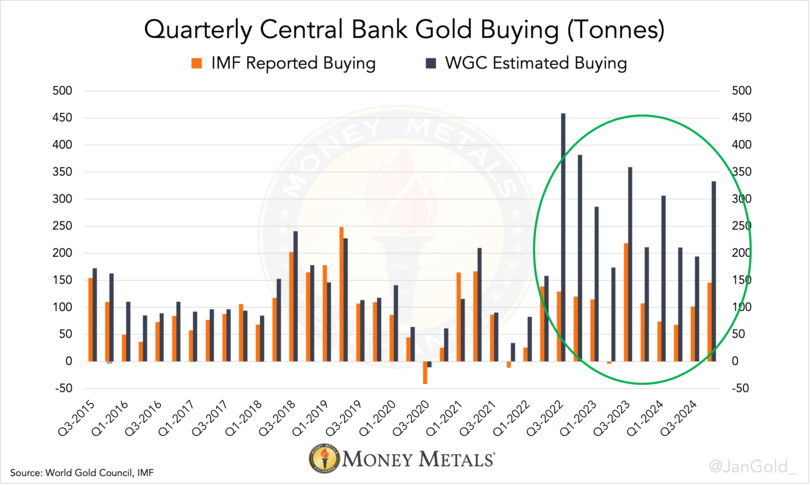
Chart 1. The difference between WGC and IMF data reflects unreported central bank gold buying.

Chart 1. The difference between WGC and IMF data reflects unreported central bank gold buying.

According to two sources familiar with the matter, but who prefer to stay anonymous, the difference is mainly caused by “unreported purchases” by the Chinese central bank.

My approach has always been to take eighty percent of the difference between WGC and IMF figures and label that as secretive Chinese buying.

For instance, using this approach, I calculated that the People's Bank of China acquired 280 tonnes during the third quarter of 2022.

In December 2022, the Financial Times published a similar estimate that confirms the accuracy of my sources and methodology:

Mark Bristow, chief executive of Barrick Gold, the world’s second-largest gold miner, said China had bought tonnes of gold around the high-200s mark [in Q3 2022], based on his discussions with numerous sources.

Gold industry insiders—whether working at bullion banks, mining companies, refineries, consultancy firms, or secure logistics companies—sometimes exchange information. It’s through these interactions that estimates are conceived about the volume of secret gold buying by the Chinese central bank.

Thus, if one has access to one or multiple nodes in this network, it can piggybank on their intelligence. More on this below.

Other evidence of the PBoC’s covert gold acquisitions is the surplus in the Chinese gold market since 2022.

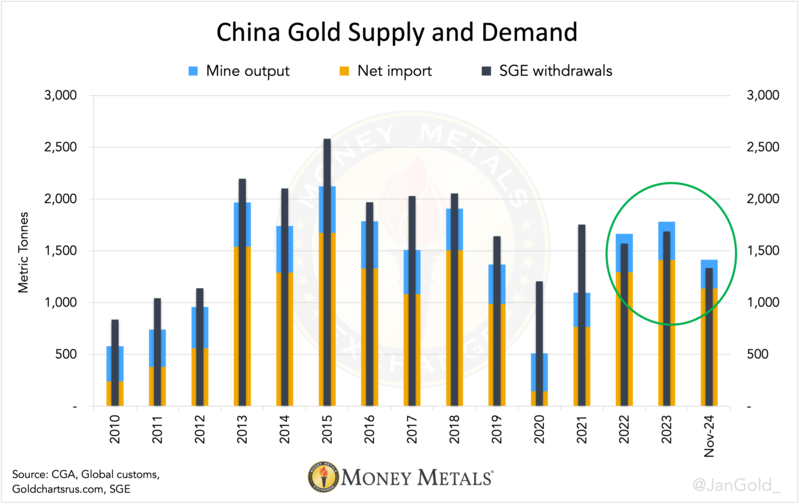
In the past three years, China’s import plus domestic mine supply exceeded withdrawals from the vaults of the Shanghai Gold Exchange (SGE). As the SGE is the center gold bourse in China—through laws and tax incentives most supply and demand flows through this exchange—an observed surplus must reflect acquisitions by the local monetary authority.
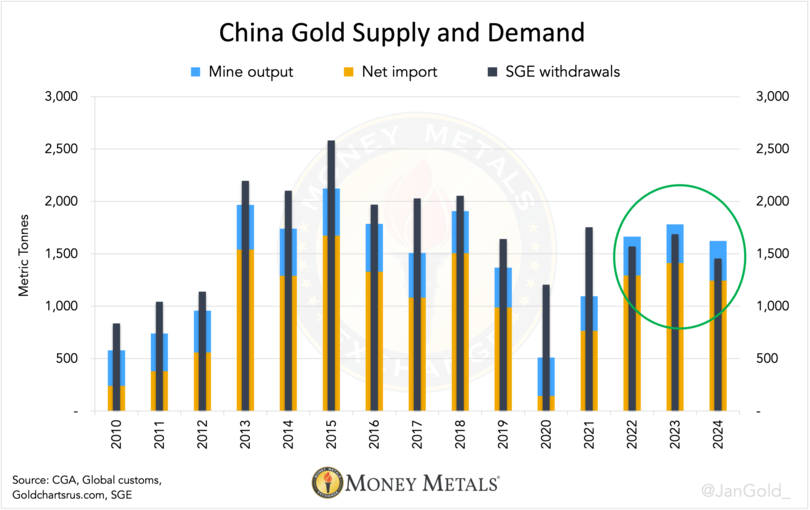
Chart 2. I’ve checked with sources close to the SGE that tell me the giant surplus is not being accumulated in SGE vaults, so it must end up in the PBoC’s vaults.

Chart 2. I’ve checked with sources close to the SGE that tell me the giant surplus is not being accumulated in SGE vaults, so it must end up in the PBoC’s vaults. 

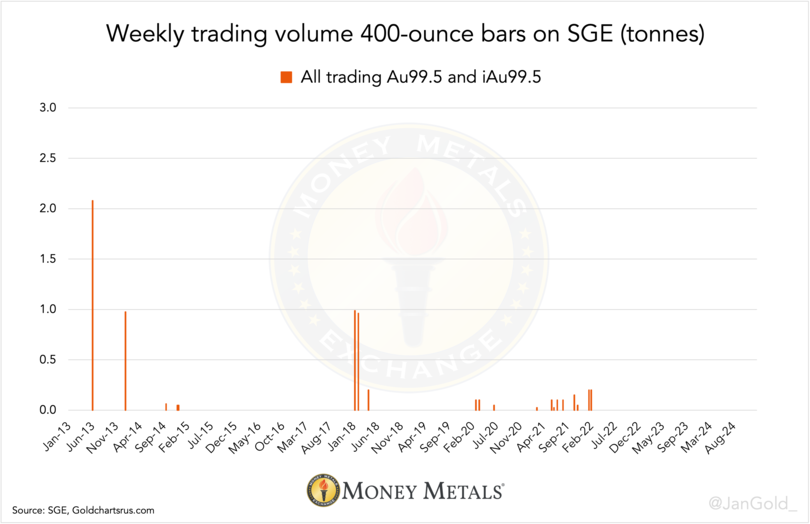
Another piece of evidence is the gold exported directly from the London Bullion Market to China. Because in London gold trade is conducted in large 400-ounce bars, but on the SGE, the private sector only trades in 1-kilogram bars, any gold moving directly from the U.K. to China is destined for the Chinese central bank.

The smoking gun as to Chinese government stockpiling is when we see a continuation of large exports from Britain to China whilst gold in Shanghai is trading at a discount versus London.

Obviously, no bullion bank would buy gold in London to sell at a loss in China. What actually happens is that the PBoC buys gold in London and lets bullion banks transport the metal to Beijing. In these circumstances, bullion banks (not the PBoC) must deal with customs departments and so the flow of gold is recorded.
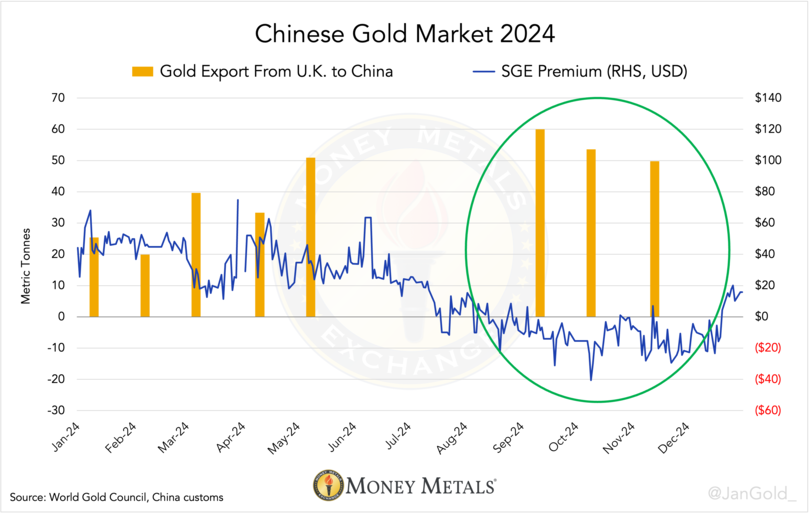
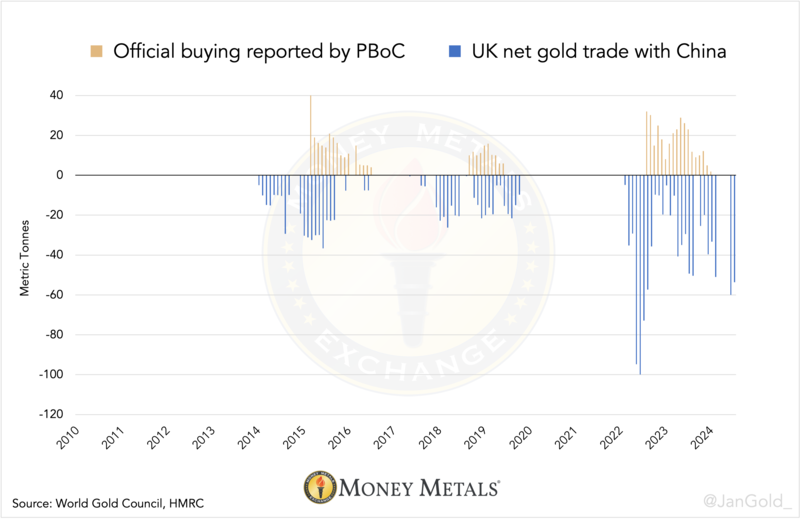
Chart 3. Gold exports of 400-ounce bars from the U.K. to China go straight to the PBoC. China’s central bank has surreptitiously bought 1,800 tonnes from Q3 2022 through the end of 2024, which is five times more than what’s officially reported.

Chart 3. Gold exports of 400-ounce bars from the U.K. to China go straight to the PBoC. China’s central bank has surreptitiously bought 1,800 tonnes from Q3 2022 through the end of 2024, which is five times more than what’s officially reported.

The PBoC Secretly Holds 5,000+ Tonnes of Gold

For dessert, let’s estimate how much gold the Chinese central bank owns in total.

We know how much gold it bought every quarter going back to 2010 when the WGC’s Gold Demand Trends data began. To get a ballpark estimate of how much it owns now, all we need is an estimate of how much it owned at any point in time since 2010.

I have been fortunate that on two occasions well connected industry insiders shared with me how much they thought the Chinese central bank owns. On the first occasion, in late 2015, an insider told me that from within his network, he tallied 3,300 tonnes. The second source was more conservative and conveyed in June of 2024 his estimate was approximately 4,000 tonnes at that time.

When I reverse engineer the second estimate to 2015, then take the average of the two estimates, and calculate what has been added per quarter ever since, it produces an outcome of 5,065 tonnes for the end of 2024.

So, to the best of my knowledge, 5,065 tonnes is the weight of fine gold that the Chinese central bank currently stores in the capital Beijing. 

China Lifts Gold in Global International Reserves

If we take into account the PBoC’s hidden gold reserves, as well as surreptitious additions by the Central Banks of Saudi Arabia and others, world official reserves reached an all-time high of 39,547 tonnes at the end of 2024.

As virtually all new monetary gold buyers are located in the East, non-Western gold holdings are rising rapidly and have reached 45% of world gold reserves. The following chart is a perfect visual representation of the shift in global power towards the East.
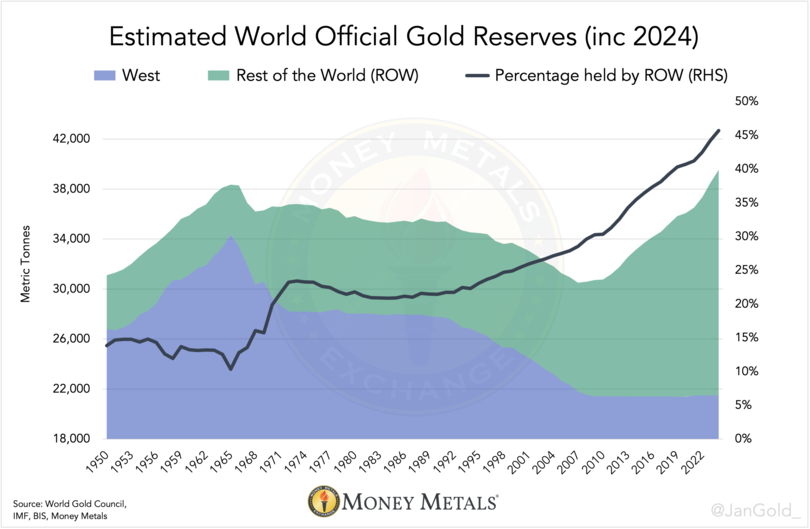
Chart 4. Non-Western central banks nearly hold as much gold as their Western counterparts.

Chart 4. Non-Western central banks nearly hold as much gold as their Western counterparts.

My personal estimates of world official gold reserves, combined with Currency Composition of Official Foreign Exchange Reserves (COFER) data by the IMF, unveil gold’s percentage of global international reserves jumped up 4%, to 21%, in 2024. That’s the biggest surge in more than four decades.
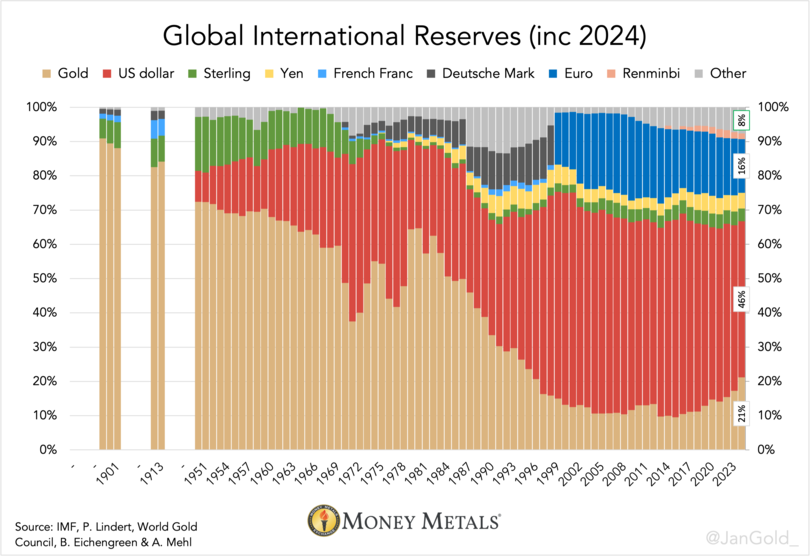
Chart 5. Next to gold, small currencies (“other”) are also on the rise in international reserves.

Chart 5. Next to gold, small currencies (“other”) are also on the rise in international reserves.

Next time you read claims that there is no de-dollarization actually occurring, please urge the naive writer to include gold in his statistics as to foreign reserves!

Notes

To properly understand why gold exports from the U.K. to China must be for the PBoC, please refer to my previous articles (herehere, and here) that take into account all the mechanics of the Chinese domestic gold market.

2024年12月28日星期六

China Secretly Snaps Up More Gold, Positions for Its Greater Global Role


While 99% of the media keeps staring at official data by the Chinese central bank (PBoC)—misleadingly stating it added 5 tonnes of gold in November following a supposed six-month pause—the PBoC’s "unreported" purchases in London accounted for a stunning 60 tonnes in September and another 55 tonnes in October.

And while cross-border trade statistics from the U.K. for November have yet to be released, I foresee another purchase of a similar magnitude.

Chinese authorities see a greater role for gold in the future international monetary system, or they wouldn’t continue buying such extraordinary amounts of gold. Via London alone, the PBoC has stockpiled 1,000 tonnes of gold since Russia’s foreign exchange assets were “frozen” by the West early 2022.

London Exports to China Are a Proxy for PBoC Buying

Since July this year, I have been writing that a large share of China’s gold imports into the domestic market is not bought by the private sector. We can conclude that the bars exported from the U.K. to China are secretly destined for the PBoC.

Initially, I based my analysis on a pronounced surplus in the Chinese domestic gold market—resulting from supply (mine, recycled gold, and imports) outstripping demand. The most conceivable explanation for this surplus is that the central bank of China is behind large gold imports.

China Gold Supply and Demand

Chart 1. From 2022 until November 2024 there is a surplus in the Chinese gold market, because import and domestically mined gold was more than SGE withdrawals.

My findings became more evident when in September the premium on the Shanghai Gold Exchange (SGE) turned negative, but Chinese gross imports accounted for a sturdy 95 tonnes for the month.

It makes no economic sense for any bullion bank to buy gold abroad and sell at a loss at the SGE. The 60 tonnes (in 400-ounce bars) exported in September from the London Bullion Market to China went to the vaults of the PBoC in Beijing, I therefore concluded.

The PBoC Keeps Up the Pace, Buying 55 Tonnes in October

I noted the following in my last article:

…we can see that in October, the SGE was trading at a discount while imports reached 95 tonnes, which was the same as in the prior month. I strongly suspect the PBoC was secretly buying gold in London again.

Recent data by Her Majesty’s Revenue & Customs (HMRC)—Britain’s tax, payments and customs authority—reveal 55 tonnes were indeed dispatched from the London region to China in October.

Meanwhile, it’s likely the PBoC also bought gold elsewhere. Total imports into the Beijing region accounted for 69 tonnes in October, as per General Administration of Customs People's Republic of China. That’s 14 tonnes more than what was shipped from London.

An illustration I shared previously is a chart of the PBoC’s publicly disclosed gold purchases versus U.K. gold exports to China. The chart shows both are loosely correlated "although the PBoC usually takes up to a year to publicly report its acquisitions and keeps about 65% of it hidden" (quote from my article from November 26, 2024).

PBOC Official Gold Buying vs UK Exports to China

Chart 3. The PBoC’s publicly disclosed gold purchases versus U.K. gold exports to China that serve as a proxy for covert buying by the Chinese central bank.

Only two months after September (when the PBoC covertly resumed buying in London), it revealed to the world it bought a mere 5 tonnes in November. Even this fraction of the truth boosted sentiment in the gold market. Go figure.

The Chinese central bank is currently buying at least ten times more gold than what you read in the newspaper, and yet markets got excited based on mere breadcrumbs!

Goldman Sachs Writes on PBoC Gold Buying in London

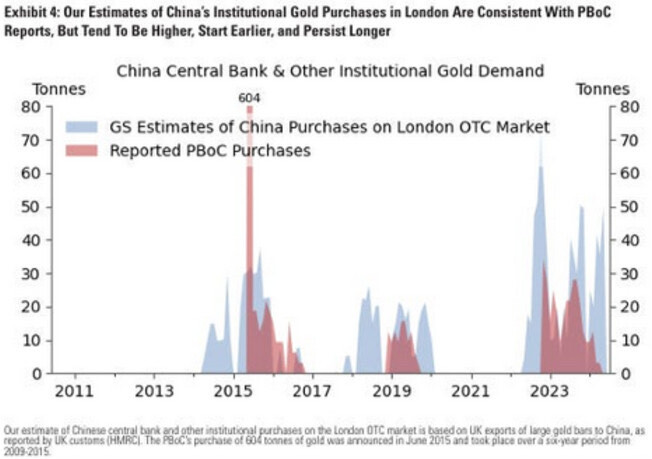
Meanwhile, my research is gaining traction as it was picked up by Goldman Sachs (GS). Below you can see a chart by GS displaying what I first demonstrated in July, but with a different design.

Goldman Sachs Sept Gold Export from UK to China

Chart 4. Courtesy of Goldman Sachs.

At the bottom it reads "our estimate of Chinese central bank … purchases on the London OTC market is based on UK exports of large bars to China, as reported by UK customs (HMRC)." (Parroting my own conclusion.) Eventually other media will start writing about these huge purchases as well.

For me, this topic reminds me of my early work analyzing SGE withdrawals. In 2013, I began spotlighting the volumes of gold withdrawn from SGE vaults, documenting why that is a proxy for Chinese wholesale demand. By implication, gold demand in China at the time was twice what consultancy firms stated. A few years later, nobody argued about the meaning of SGE withdrawals anymore.

Gold’s Role in the International Monetary System Will Increase

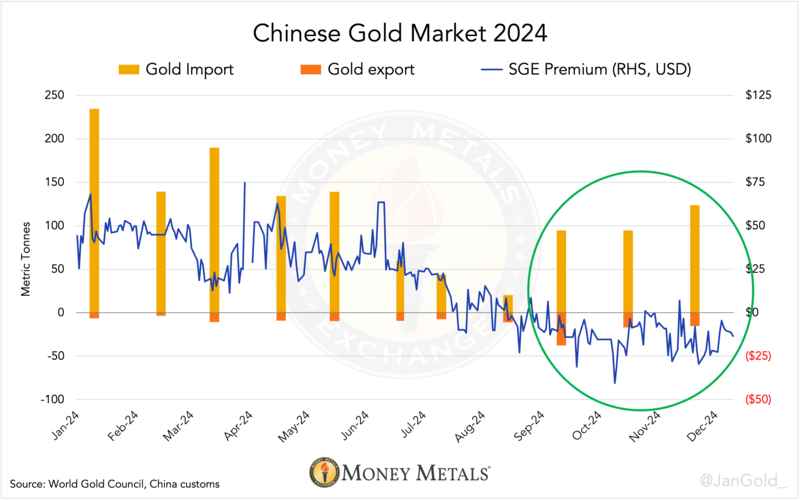
In November, gold on the SGE was still trading at a discount, yet Chinese gross gold imports swelled to 122 tonnes. No doubt the PBoC struck big in the London Bullion Market once again.

Chinese Gold Market 2024

Chart 5. The Chinese central bank orders gold abroad at bullion banks and outsources transport to Beijing to those banks, making them have to register the metal at customs.

My latest estimate of the PBoC’s true gold holdings is roughly 5,000 tonnes, a number that is in stark contrast to what the Chinese divulge to the IMF, i.e. 2,271 tonnes. (I will substantiate my estimate in a follow up article.)

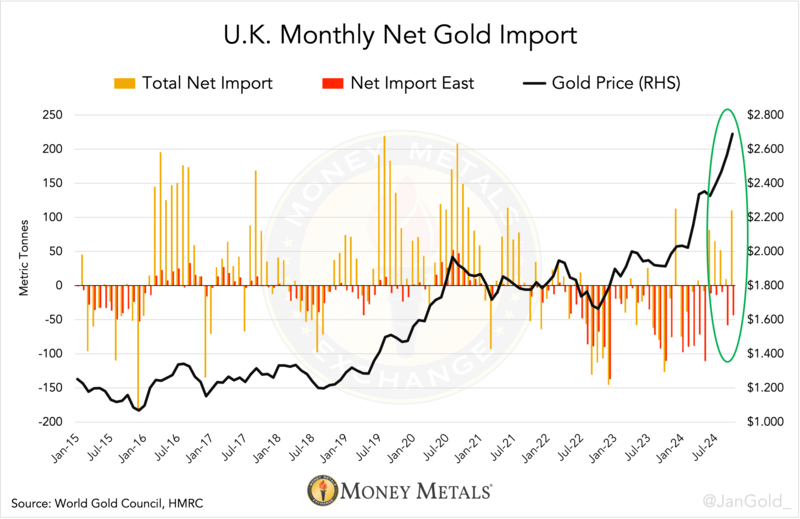
Tellingly, it seems some large investors in the West are sniffing out the momentous developments in the gold market. Although the U.K. was a gross exporter of 55 tonnes to China in October, the U.K. itself net imported 110 tonnes.

Who bought? Most likely institutional money as ETF holdings stored in London increased by only 18 tonnes, according to statistics compiled by friend and data wrangler Nick Laird from GoldChartsRUs.com.

UK Monthly Net Gold Import

Chart 6. Western institutional money must be buying gold too, because London inflows are substantial. As an aside, HMRC’s numbers show mostly mining countries exported to the U.K. (Australia, Canada, Kazakhstan, South Africa, United States, Uzbekistan), next to Germany, Singapore, and Switzerland.

These are exciting times indeed for gold.

China’s monetary authority doesn’t buy gold for no reason at a pace of approximately 60 tonnes a month from Great Britain alone—now 1,000 tonnes in total since the war in Ukraine. The Chinese obviously see a greater role for gold in the international monetary system going forward.

Over the same 30-month period, the value of China’s holdings of U.S. Treasuries has declined by $250 billion.

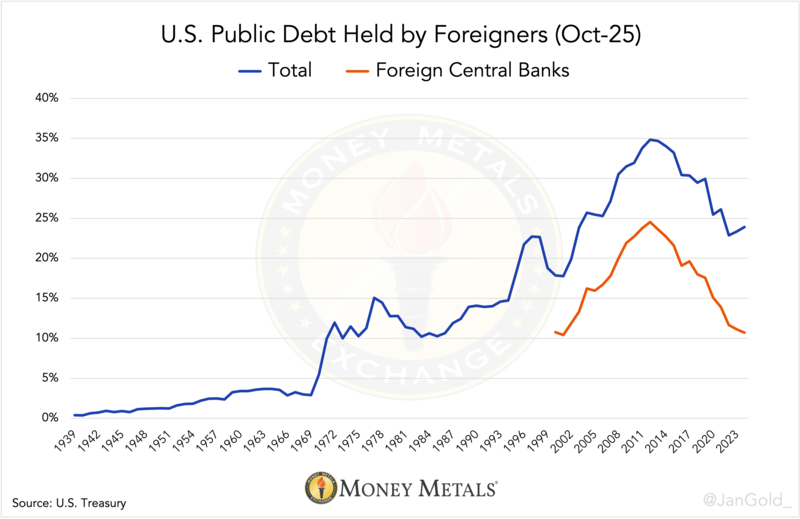
What we’re witnessing a shift from "dollar recycling"—the status quo from 1971 through 2021—to "gold recycling." Instead of investing trade surpluses in dollars, countries are increasingly choosing for gold.

The Saudi central bank is also buying gold under the radar, next to many central banks buying openly.

As a result, less and less of the U.S. its excessive public debt (122% of GDP) is financed by foreigners, let alone foreign central banks. This forces Treasury to either reduce the fiscal deficit (currently 6% of GDP, good luck!), pay higher interest rates and accelerate the debt spiral, or print its way out of this through inflation.

In addition to dollar weaponization, the (global) debt overhang is a motive for central banks to increase their gold reserves, as historically inflation is the most common big way of restructuring debts.

Percentage of US public debt held by Foreigners Oct 25

Chart 7. The U.S. public debt is unsustainable.


原文連結