2012年8月15日星期三

Why The Government Is Destroying The U.S. Dollar

終於找到原文 .......

http://www.marketoracle.co.uk/

Interest-Rates / US Debt Aug 14, 2012 - 11:44 AM
Interest-Rates
Diamond Rated - Best Financial Markets Analysis ArticleThe United States government has five interrelated motivations for destroying the value of the dollar:
1. Creating money out of thin air on a massive basis is all that stands between the current state of hidden depression, and overt depression with unemployment levels in excess of those seen in the US Great Depression of the 1930s.


2.  It is the most effective way to meet not just current crushing debt levels, but to deal with the rapidly approaching massive generational crisis of paying for Boomer retirement promises.
3. It creates a lucratively profitable $500 billion a year hidden tax for the benefit of the US government which is not understood by voters or debated in elections.
4.  It is the weapon of choice being used to wage currency war and reboot US economic growth; and
5. It is an essential component of political survival and enhanced power for incumbent politicians.
In this article we will take a holistic approach to how individual short term, medium and long term pressures all come together to leave the government with effectively no choice but to create a substantial rate of inflation that will steadily destroy the value of the dollar. 
If you have savings, if you rely on a pension, if you are a retiree or Boomer with retirement accounts - any one of these five fundamental motivations is by itself a grave peril to your future standard of living.  However, it is only when we put all five together and see how the motivations reinforce each other, that we can understand what the government has been and intends to continue doing, and then begin the search for personal solutions.

Reason One:  The Political Interests Of Self-Serving Politicians

As further covered herein, almost 9% of the US economy is currently funded by deficit spending.  From a political perspective, this $1.3 trillion a year is "free money" that politicians get to disburse on a political district and favored special interest group basis.  In other words, roughly $1,000 per month, per American household can be used to reward friends and can be withheld from enemies, with personal credit being taken by the benevolent politicians for this never-ending largess.
In past decades, politicians were restricted to spending perhaps $200 or $300 per month per household over and above what the government was collecting in taxes, with the difference being borrowed in the bond market.  Anything above that would require the unpleasantness of raising taxes, which might put individual politicians in danger of actually losing their position and privileged lifestyle if he or she wasn't in a "safe" district.  However, in the current climate all limitations are gone, the pork is rolling out on a historically unprecedented basis, and the politicians are wielding unprecedented power.
So why do the limitations usually exist on at least some level, and why are they gone now? Historically, the US government has directly created money out of thin air on a massive basis to fund deficit spending during the Civil War, and also during the Revolutionary War. There is a very good reason such governmental actions are so rare:  the value of the US dollar was rapidly destroyed in both instances.  So, this spending without limit would not ordinarily be a sensible path.  Unless, from the government's perspective, there were other dangers that were considered a greater threat, that could be addressed only through destroying the value of the dollar.

Reason Two:  To Hide A Depression

I have written numerous articles about various aspects of Reasons Two through Five for some years now, and my long term readers and subscribers have been well aware of the building pressures.  While the emphasis of this article is on the interweaving of the short, medium and long-term relationships between the five reasons, we will first set the stage by taking a few paragraphs each to briefly review the individual government motivation, with a link to a full length article that covers the problem in more depth.  
While you wouldn't know it from government press releases or media headlines, there has been a gaping hole in the US economy since 2008, as illustrated below:
During the first round of the financial crisis, the US private economy nearly collapsed, threatening to send the US economy straight into deep depression.  We're talking about a $1.3 trillion private sector collapse that was contained only by the government fantastically increasing the money it spent, even while tax revenues were falling.  The creation of huge government deficits has been all that has maintained even a facade of semi-normalcy.  Remove the mechanism of the government creating money so that it can spend what it doesn't have, and it is straight to official Great Depression-level unemployment in months.
Even as the true gravity of the situation is hidden from the general public, so too is the true cost of the grossly irresponsible short-term "band-aid" that is being used to cover the hole in the US economy.  The destruction of the value of savings in general, as well as the impoverishment of Boomers and retirees in particular, is explained in my article linked below, "Hiding A Depression:  How The US Government Does It."

Reason Three:  A Desperate Attempt To Escape Depression By Waging Currency War

The US government has been waging currency war since September of 2010.  Simply put, the US would have great difficulty emerging from the depression described above so long as the US dollar is "strong", because a strong dollar translates to "expensive" US workers who have difficulty competing for market share even in the US economy, let alone abroad.  One solution is that when a nation slashes the value of its currency, its workers become relatively cheaper, and they then cannot only better defend their domestic market share, but can begin to take market share in foreign economies as well.  However, when a major nation goes on the offensive, many trading partners will counterattack and try to defend their economies, not by making their own currencies stronger, but by making their own currencies weaker, so that their domestic workers remain relatively inexpensive and will be better able to compete for market share.
 To successfully go on the currency offensive and negate attempted counterattacks, Federal Reserve Chairman Bernanke chose a radical tool - he publicly announced that the Fed would be directly creating money on a massive scale equal to 9% of the US economy, with the proceeds going to purchase US government debt in the secondary markets.  Ultimately, the only protections for a symbolic currency (such as the US dollar) are the policies deployed by the central bank to maintain that value.  And when the nation's chief central banker directly threatens to use his power to destroy the symbol rather than preserve it - the threat is extraordinarily effective. 
There is no free lunch, however.  While the US government is insisting to the world-at-large that it is not engaged in currency warfare, in order to maintain the plausible deniability that is essential to diplomatic doublespeak, it is also hiding the heavy cost from its own citizens.  The US standard of living since the late 1990s has been based on having a "strong" dollar and huge trade deficits - meaning we haven't actually been able to pay for what we consume for a long time.  Therefore, even as jobs and the real economy grow, there is a drop in the overall standard of living, that is not evenly weighted - but is disproportionately born by savers, Boomers and retirees. 
Much more information on how this works and the specific ways that older citizens will be bearing most of the pain can be found in my article linked below, "Bullets In The Back:  How Boomers & Retirees Will Become Stimulus, Bailout & Currency War Casualties".
These second and third elements of hiding a depression and waging currency war are tightly interwoven, and could even be called "killing two birds with one stone".  The money doesn't exist to keep the US from openly plunging into depression, it simply isn't there for a fiscally responsible government.  And covering the economic hole by creating money out of thin air at a rate equal to 9% of the total US economy is so fiscally irresponsible that few nations dare a counterattack of such magnitude.  For now, massive monetary creation allows the US to not only cover over the current hidden depression, but also to wage all-out currency war to try to emerge from that depression.
However, to fully understand the agenda of the US government, we have to look at the greatest financial problem of all, and how destroying the value of the dollar is the intended solution.

Reason Four:  Dodging National Bankruptcy

Sometimes households reach the unfortunate point where when they add up the credit cards, mortgage payments, and 2nd mortgage payments - they realize that they will never be able to pay their bills.  They know they are bankrupt and there is no way of dodging that.  But instead of reducing their spending - they may even step up the spending, until all the lines of credit are maxed out, and the bills are all in arrears.  Because, once you know bankruptcy is inevitable anyway - why slash your standard of living before you absolutely have to?  Partying it up now for another few months won't change the destination, so why not?
Fortunately, relatively few ordinary people think that way.  There is ample evidence, however, that a good number of politicians hold that mindset when it comes to budget deficits that appear impossible to repay, at least in the conventional manner. 
There is a lie that is being frequently repeated, which is that our children and grandchildren will be slaving away for decades to pay back the money that we've been borrowing to fund this reckless deficit spending.  The assumption underlying the lie is that if it weren't for the current spending, the nation would be fine, and therefore increased taxes will be needed to pay back the borrowing. 
Except that the nation isn't fine.  Like most other major developed nations in the world, the United States has been effectively bankrupt for quite some time, with a day of reckoning that is approaching fast with or without the current outrageous level of deficit spending. 
The graph below is from my article, "Six Layers Of Deficit Impossibilities Mean Retirement Catastrophe".
http://danielamerman.com/articles/2011/LdeficitC.html
As developed step by step in "Six Layers", when we add up current and future Federal deficits, as well as unfunded Social Security, Medicare and other unfunded government promises, the total comes to over $785,000 per non-retired household (over the coming years) that has an above poverty line income.  And this isn't even the total cost - it is the excess cost over and above current estimated tax receipts, which assumes a healthy and growing economy.  When we drop the assumption of an economy growing at the same rates of the last 50 years, then the shortfall goes far higher - perhaps over $200 trillion for Social Security and Medicare alone by some recent estimates.  That would raise the total shortfall to over $2 million per non-retired and above-poverty-line household.
If taxes can’t pay (and it’s ludicrous to think they can), and the US doesn’t declare bankruptcy, then just how do we cover the gap?
Short answer:  pay in full, but make the dollar worth five cents.  This drops the per household cost for everything from almost $800,000 down to about $40,000.  Painful, but manageable over a period of 20-30 years.
Merely make a dollar worth five cents, and impossible government promises become quite payable.  The problem with this "solution" is that it also requires making most people's life savings worth five cents on the dollar.

Reason Five:  Create A Massive Hidden Tax

The Federal Reserve effectively controls short, medium and long-term interest rates in the United States, and this means that it controls the borrowing costs of the United States government.  As developed my article linked below, "Hiding A $500 Billion Tax On Savings:  How The Government Deceives Millions", by forcing interest rates below the rate of inflation, the Federal Reserve creates about a half trillion dollar per year "windfall" gain for the Federal government.
http://danielamerman.com/articles/2011/SaveTaxC.html
This is not "free money", far from it.  Every dollar of benefit for the government from interest rate manipulations comes directly out of the pockets of savers.  That is, for the government to come out ahead by $500 billion per year requires savers and pension funds to come up short by $500 billion per year.  This makes it a tax in all but name.  It is also essential to note that two elements have to come together to make this hidden tax work:  1) there have to be low interest rates, and 2) there also has to a substantive real rate of inflation (which can be quite different from the official rate).
From a politician's perspective this massive tax - almost three times the size of federal corporate taxation - is a "dream tax".  Half a trillion dollars a year is available to spend without raising taxes or increasing deficits.  Sure, there is a cost, which is the entirely deliberate destruction of retirement dreams and promises for tens of millions of US workers and retirees - particularly Boomers - as well as pushing forward the insolvency of state and local government pension funds around the country.  But the deliberate bankrupting of a generation is a long term problem with no clear accountability and almost no voter understanding, which means it is more or less irrelevant for how political decisions are made today.

Look For The Silver Lining: Silver Swan Ready For Takeoff

http://goldstocktrades.com/


An old melody advises us to look for the silver lining whenever dark clouds appear in the blue.  There is economic and political upheaval all over the world, especially in the South China Seas.  This may directly affect the world’s supply of industrial metals such as graphite, rare earths, molybdenum and tungsten.
Today we direct our attention to an area where silver is shining.  Poor man’s gold may come into prominence shortly and provide our subscribers with possible profits.

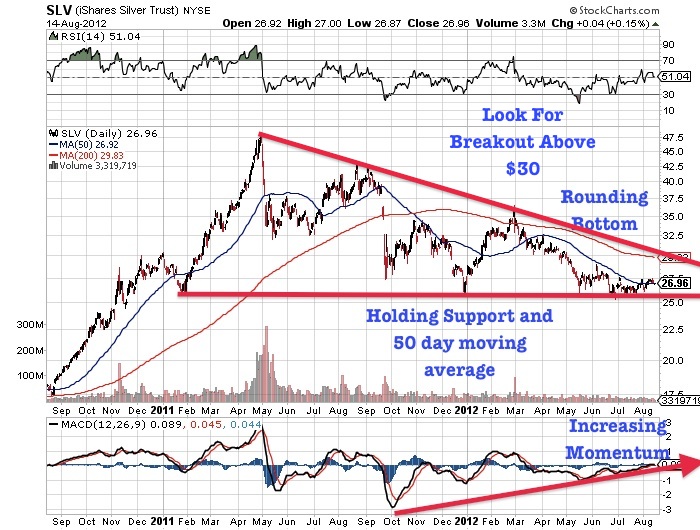
The silver battlefield is filled with bulls and bears fighting for dominance.  Recently, the poor man’s gold has dropped to the $26 area.  The struggle continues between the opposing sides.  The bulls and bears are keeping their eye on this critical support level at 2011 lows.

We sense that the bulls will prevail at this mark.  The reasons to buy silver now is compelling.  The U.S. dollar may have already reached an interim top as investors realize that the employment situation in the U.S. is still a concern and that the Federal Reserve will need to implement some form of QE3 to devalue the dollar to pay off soaring deficits and promote inflation possibly announced at the end of this month in Jackson Hole.

The bears disagree and claim that silver will be pushed back beneath this level as silver plunges to new lows as the Fed continues to keep its trigger off of the QE3 bazooka and wait until after the election.  Silver is holding the line making a rounded bottom.  Notice the rounding bottom signaling a potential breakout as sellers become exhausted.
 

On the supply side, silver production comes mainly from Peru and Mexico where miners are facing significant challenges including violence.  Newmont is having to deal with violent protests in Peru which reminds us of what Fortuna Silver had to deal with in Mexico.  Right now, Pan American Silver is suspending investment in its flagship Navidad Project due to the rising resource nationalism in Argentina.  Pan American paid $500 million for the asset in 2009.  This project may be the richest undeveloped silver deposit in the world.

Similarly, Bolivia and Evo Morales is considering nationalizing South American Silver’s(SAC.TO) large undeveloped silver project amidst violent indigenous protests.  The company describes it as “one of the world’s largest undeveloped silver deposits.”  The company is planning to invest over $50 million into the project.  At the same time the Bolivian peasants have violently kidnapped five workers from the project.

Such turmoil in Peru, Mexico, Argentina and Bolivia may add to the world’s already existing shortage of silver.  This supply crunch is combined with rising political uncertainty in Egypt, Syria and Iran and economic malaise in the EU and the United States which is causing investment demand for silver to rise exponentially.
All signs are pointing to a possible global inflation which could propel silver prices higher.  We have record deficits in the U.S. where many citizens are looking to protect their savings from a potential devaluation to pay down record debts.  With the recent Obamacare Supreme Court Ruling entitlement spending will soar.
Former Federal Reserve Chairman, Alan Greenspan noted in 2010 that “Only politically toxic cuts or rationing of medical care, a marked rise in the eligible age for health and retirement benefits…or significant inflation… can close the deficit.”
Remember, in response to Keynesian pump-priming inflation threatens to make silver increasingly attractive as a safe haven.  There is always the presence of increased industrial demand for the poor man’s gold.  Silver is being used increasingly in high tech applications from batteries to solar panels.

Last month the silver etf’s added 293 metric tons of this valuable metal to their holdings which represents their highest inflows since September.  The bears claim that silver’s proximity to the $26 line is a negative signal and are pushing below their 50 and 200 day moving averages on the way to $18.

Recall that silver is volatile and moves up or down more than other commodities such as gold.  On the other hand, QE3 if it is implemented will encourage monetary easing internationally and thus will boost silver prices.

After QE2 we called the silver breakout to the day on 8-25-10.
Silver soared from $18 to close to $50 outpacing other commodities.  If QE3 is carried out, silver could experience a similar type of move.  In such an event, the specter of inflation may trigger silver’s rapid ascent into new all time highs.  We regard silver as a long term holding which may be ready to move into new all time highs past $50 depending in part on the Fed’s next move.

Silver follows Gold and responds similarly

The greatest approach to investing in silver is looking at the long term outlook and remaining patient.
LOS ANGELES(BullionStreet): At the moment,Silver is attracting first time investors and causing long term investors to beef up their holdings, according to Stephen M Smith, managing member of Smith McKenna LLC.
Smith said the white metal has been relatively stable at a price that many would consider cheap and most people miss out on investing in silver and the potential wealth creation opportunities because of uncertainty and lack of information.
It's the perfect time to learn about a silver investment because historically, silver is exceptionally cheap right now," he added.
Last week however, silver edged into the $28/ounce territory showing signs that it likely won't remain at this cheap price for very long.
Analysts are firmly set on silver being due for a strong rebound, especially with the recent surge of increased investor interest.
Those who have been considering whether or not to invest in silver, should be getting all the information they can and buying right now; ahead of the next boom.
The greatest approach to investing in silver is looking at the long term outlook and remaining patient.
Historically, silver follows a common path and responds similarly to its costlier friend gold.
With the potential for increased inflation through stimulus efforts in the U.S. And Europe, along with positive global manufacturing outlook data; silver could soar virtually overnight.
Precious metals should be a part of any investment portfolio as a means of diversification. According to Smith, "Silver could perform stronger and be a better investment vehicle than your IRA/401k."
Precious metals are expected to remain strong, especially silver over the next few years. Because of projected interest rates, the stock and bond bubble, and global economic recovery; silver could see a spot price as high as$100an ounce or more in the near future.
Silver, gold and other precious metals will always be worth more than paper commodities because they are a physical asset and finite in supply.
Mined silver has increased very little in 2011 at roughly 1.4% and is expected to be very similar in 2012 as well. As other investment and monetary forms depreciate, precious metals thrive, especially with limited supply.
Analysts at HSBC said, "We retain our bullish view on gold for the second half of 2012. We expect prices to rally to above $1,900/oz by the end of the year."Silver will likely follow suit, and could surge to $50/oz.

2012年8月14日星期二

新政府應檢討強積金

強積金「半自由行」將在11月1日開始,現在各強積金供應商和中介摩拳擦掌。近期媒體關於強積金的專題報道固然大增,對打工仔投資強積金的調查亦陸續有來。熱鬧情況不減當年世紀之初強積金面世時。

強 積金這個打工仔退休保障計劃的誕生,是殖民時代和特區政府不願意承擔全民退休保障的折衷產物。折衷的結果,自然差強人意。按理低收入的打工仔最需要這個制 度保障退休生活,以免加大綜援壓力。但低收入群體在工作30多年所累積強積金金額,難以應付退休後基本生活的開支,而每個月少了5%收入,大大影響到他們 現在的生活。有能力照顧自己退休生活的人士,則不甘心每月可動用收入減了。老闆則認為僱主供款是增加了企業經營成本,特別是香港中小企業多是艱苦經營。強 積金推行至今12年有多,依然有這麼多的反對聲音,持份者不高興是主因。

制度致收費高昂 蠶食回報

強 積金制度架牀疊屋,也受識者異議。強積金是強制投資,投資產品理應可以是現成的產品,例如證監會認可基金(或其中部分)、香港上市公司股票、香港政府機構 和企業發行債券、香港上市ETF等等。但強積金要自成一家,信託公司需要在香港註冊,並獲積金局批可。強積金供應商成立的強積金計劃,下有成分基金、成分 基金下有核准匯集投資基金,核准匯集投資基金可以是保險保單或信託形式的基金或互惠公司形式的基金。而不少核准匯集投資基金是香港證監會認可的基金。計劃 可以有收費、成分基金又可以有收費、核准匯集投資基金又有收費。強積金供應商究竟免了多少收費,就看市場力量和供應商良心。

那為什 麼不讓打工仔和僱主直接投到這些證監會認可基金?香港證監會認可基金1000多隻,論數目、投資市場分佈、投資風險分佈、投資範圍都較現在的強積金成分基 金多和廣。雖然現在證監會認可基金少有在香港註冊,但如果積金局要求只可以投資在香港註冊的基金,相信很多基金公司會把註冊地轉到香港(回歸前有多隻投資 香港或大中華的基金是在香港註冊),或成立香港註冊的子基金或複製基金。這個安排行政上可行,而且可以省下不少強積金費用。

實施12年成效受質疑

2000 年的強積金,不少金融機構曾經憧憬商機無限。但當時強積金計劃是由僱主挑選,僱員無從干預。斯時識者已經提出問題,認為僱主會有其他考慮,多會挑選與業務 密切相關的金融機構,有人估計香港最大的姊妹銀行集團將會壟斷市場。果不然它倆佔了強積金市場一半份額。如果以香港現在的政治氣氛,反對大財團霸氣的力量 不輕(地產霸權、佔領中環),這種僱主決定的安排必受立法會部分議員質疑,不輕易獲得通過。

強積金制度實施了12年多,成效強差人意。香港需要全面的退休保障以至社會保障制度。強積金制度雖能部分解決退休保障的問題,但已不能呼應社會需要。梁班子如想有所作為,應該慎重研究社會保障制度和檢討強積金制度。
陳茂峰博士 CFA, CFPCM 御峰理財董事總經理
明報

Greece Seen Waiting for Euro Exit Order From EU

黃金再貨幣化進程評估

黃金再貨幣化進程評估 - 財經要聞 - 中金線上

  徐以升 余懿

  1971年8月15日美元與黃金脫鉤,一直到2000年瑞士貨幣完成“去黃金化”,黃金最終在國際貨幣體系裏沉默。但自2008年全球金融危機以來,黃金貨幣化進程卻悄然加速。

  黃金價格的走勢,已經超脫了大宗商品屬性。而美國、瑞士等國正在或者將要推進的黃金貨幣化立法,則昭示著一個傳統幽靈的回歸。

   佈雷頓森林體系解體至今,全球紙幣體系已運行了40年。紙幣體系之下,財政赤字、主權債務貨幣化大行其道,美國、英國、日本、歐洲央行無不如此,貨幣發 行的無約束性已經凸顯,這挑戰了貨幣的基本定義。如何約束貨幣發行,將成為未來國際貨幣體系改革的核心原則性要求。眾多意見領袖認為,即便不會回歸金本 位,在未來的貨幣體系中,黃金也將扮演某種角色。

  實際上,貨幣的五種職能包括價值尺度、流通手段、支付手段、貯藏手段、世界貨幣的職能,黃金的這五種貨幣職能均在恢復進程之中。

  金價走勢已凸顯貨幣屬性

  黃金的貨幣化進程目前已經在其價格波動中不斷顯現,其理由有五個方面:

   第一,黃金大宗商品屬性大幅減弱。在對黃金的需求中,工業需求僅佔10%,而金飾需求和投資需求佔90%。這表明,黃金的工業需求對金價的影響已經大幅 削弱,其大宗商品屬性已銳減。同時,投資需求佔總需求的比重在近10年來高速增長,已由2001年的9.5%上升至34.5%,價值貯藏功能增強,貨幣屬 性逐漸強化。

  第二,黃金價格已經不再與美元反向運動,這凸顯了黃金本身的貨幣屬性。過去的長週期中,黃金一直作為美元的對手方出現, 美元的上漲往往意味著金價的下跌。然而,如今,黃金和美元較為簡單的負相關關係已不復存在,黃金開始獨立於美元之外,同時也獨立於歐元之外,與兩大儲備貨 幣逐漸呈三足鼎立之勢。

  第三,在2008年9月雷曼破產、2011年8月美國國債評級下調兩次市場暴跌走勢時,全球外匯市場動蕩,股市一瀉千里,大宗商品價格暴跌,黃金價格卻未隨大宗商品暴跌,反而脫穎而出強勁上漲,昭示其大宗商品屬性明顯衰弱,價值貯藏功能增強。

   第四,黃金價格開始與金融市場壓力指數呈一定的正相關,而這是此前美元等世界貨幣所特有的。“Ted”利差 (3個月美國銀行間拆借利率和3個月財政部票據利息的利差)、BBB-AAA 利差(評級為“BBB”的債券和評級為“AAA”的債券利差)是IMF衡量全球金融市場壓力大小的重要指標。對比黃金價格走勢與以上指標發現,當金融市場 壓力增大時,Ted Spread和BBB-AAA利差均會大幅上升,而金價也隨之出現大幅上揚,反之亦然。這凸顯了黃金貨幣屬性的逐步回歸。

  第五,黃金一直以來對全球緊張局勢高度敏感,價值貯藏功能極強,這也是黃金價格波動中貨幣屬性的有力證明。

  黃金貨幣化立法進程加速

  實際上,最近兩年來,黃金貨幣化立法的相關進程正悄無聲息地進行。美國政府、美國州政府及瑞士分別通過了相關法案,認可黃金的貨幣功能。這些法案中都規定,將發行黃金或金銀貨幣,並明確了這些貨幣與紙幣一樣擁有法定地位,金銀買賣所需要繳納的資本利得稅也得到廢除。

  此外,部分法案規定,公民可以直接使用黃金或金銀貨幣來償還債務、支付稅金和各類費用,其效果等同於貨幣,這更表明瞭黃金作為貨幣的支付手段功能的回歸。這意味著黃金的貨幣化已經出現了重大突破。

  美國自1792年起實行金本位制,但1934年起持有黃金開始被視為非法。1975年1月1日,美國公民重新獲准擁有黃金。1985年,美國通過金幣法案,開始推廣金幣,且金幣作為貨幣已擁有支付功能。

   2008年金融危機以來,美國17個州政府啟動立法進程,擬將黃金的法定貨幣地位寫入法律。已經通過法案的猶他州法案(法案號:H.B.317H10) 明確,黃金和白銀在猶他州正式成為被聯邦法律保護的法定貨幣;黃金和白銀可以被用於向州政府繳納稅款;公民持有黃金、白銀,且因黃金、白銀的價格變動而產 生的收益部分不必繳稅。

  此外,美國賓夕法尼亞州眾議員Creighton等人于6月17日提交了名為《貨幣行動法案》(法案號 H.B.1690),目前眾議院金融委員會正在就該提案展開調研。法案明確,黃金和白銀鑄幣應該被作為法定貨幣;黃金和白銀鑄幣在流通過程中,不得收取任 何資本增值稅。

  該法案強調,預算和金融委員會必須研究,建立一個全新的貨幣制度以取代當前紙幣制度的可行性。賓州預算和金融委員會應當考慮在本州內建立替代當前制度的可能性,從而使得在本州內可以使用其他形式的貨幣來償還債務、支付稅負和各類費用。

  美國明尼蘇達州提交的法案(法案號為H.F.1664),申請將金銀鑄幣確定為本州的法定貨幣,且可用於流通使用,並免征稅負。該法案5月9日提交,目前還未進入眾議院討論程式。

  該法案強調,目前明尼蘇達州政府的一切債務均由美聯儲發行的紙幣償還,而非金銀鑄幣,這對明尼蘇達州的市場經濟和金融體系存在著不可存續的威脅,因此,應當考慮重新按照美國憲法修訂本州法律,從而將黃金和白銀鑄幣作為法定貨幣,使金銀鑄幣的法幣地位得到保護。

  4月26日,南卡羅來納州議員Pitts、Atwater等人發起了一項名為“將黃金、白銀作為本州的法定貨幣”的法案(法案號H.4128),目前該法案正在等待表決。該法案也明確,將黃金和白銀作為南卡羅來納州的法定貨幣,並可用於償還債務、支付稅負及公共費用。

   此外,美國佐治亞州的議員1月24日再度提交了《憲法法幣行動法案》(法案號H.B.3),目前,該法案正在等待佐治亞州眾議院的貨幣和銀行委員會的調 查聽證,以決定是否採納,該法案的主要內容是:根據美國憲法規定的,各州政府只能以黃金或白銀鑄幣的形式償還債務,本法案試圖確定佐治亞州只能以上述形式 償還州政府債務。本法案要求,佐治亞州內的任何銀行或其他貸款機構在州政府或其他監管機構存放的準備金可以使用金銀鑄幣,取回的準備金形式也可以是金銀鑄 幣。

  除了美國之外,瑞士也在推進黃金的再貨幣化立法進程。瑞士議會7月23日披露,將於2011年晚些時候討論“金瑞郎”議案,以發 行與現行的瑞士法郎並行的金瑞郎。發起該法案的是瑞士國內目前最大的政黨——瑞士人民黨,因此該法案很可能最後成功通過,而這僅僅是瑞士人民黨的“健康貨 幣”( Healthy Currency)計劃的一部分。

  瑞士在2000年“修憲”行動中,將黃金與瑞郎的掛鉤解除,成為最後一個放棄金本位制的國家,當時瑞士人民黨強烈反對修憲放棄金本位,但因實力弱小而無法抗衡。而目前瑞士人民黨已是議會第一大黨,2011年下半年“金瑞郎”提案通過的可能性較大。

  金融市場已經認可黃金的貨幣地位

  黃金在金融市場上也在開始重啟貨幣化,價值尺度、支付手段、流通手段職能紛紛開始回歸。表現有三:

   一是黃金在金融市場上已逐漸成為公認的抵押品,如歐洲的結算所、芝加哥商業交易所、摩根大通已接受黃金作為抵押品;二是諸如國際對衝基金Osmium Capital等機構,開始提供以黃金的盎司數定價的股份,表明黃金的流通手段職能也開始回歸;三是美國頒布多德弗蘭克法案,禁止美國的黃金OTC(場 外)交易,這一舉動意義深遠,很可能將進一步提高黃金在其國內的金融地位。

  5月25日,歐洲議會經濟和貨幣事務委員會一致同意,允許 結算所按照《歐洲市場基礎作業監理改革提案》(EMIR)的規定,接受黃金作為抵押品。上述提議被提交至歐洲議會和歐盟理事會,並將舉行新一輪投票。此前 在2010年晚些時候,歐洲主要的衍生品清算行ICE Clear Europe已成為歐洲首家接受黃金作為抵押品的清算所。

  此外,芝加哥商業交易所于2009年10月起宣佈,接受黃金作為所有交易品的抵押品,以黃金充當抵押品的總價值上限為2億美元。摩根大通2011年2月8日宣佈,旗下摩根大通抵押品管理業務將接受實物黃金作為抵押品。

   美國頒布的多德弗蘭克法案,禁止美國的黃金OTC(場外)交易,這一舉動意義深遠。但是,我們認為,在全球由黃金去貨幣化再度轉向黃金貨幣化之時,美國 禁止本國公民在場外交易黃金“自斷手足”的可能性不大。相反,禁止OTC交易,將使得實物黃金在金融市場之外,人們的生活中只能以黃金鑄幣的形式存在,從 而將黃金交易市場和人們的生活隔離開,大幅增強了黃金鑄幣在流通中的唯一性,反而很可能進一步提高黃金在其國內的金融地位。

  黃金會捲土重來嗎?

  黃金的貨幣化進程還體現在價值儲備等貨幣屬性被全球央行逐步認可上。

  以歐洲發達國家為主的CBGA(央行售金協議)國家,如今已幾乎不再對外出售黃金,即便在各國面臨主權債務償還壓力的背景下,也並未售出黃金儲備。

  不僅如此,新興市場國家也開始認可黃金的價值貯藏職能,並大幅增持黃金。墨西哥央行2011年至今已增持近100噸黃金。預計世界各國央行2011年黃金買入量將遠超前幾年。

   綜合來看,在交易者層面,黃金的大宗屬性已經大幅減弱,在交易者的眼中,黃金的貨幣屬性已經開始回歸。在全球主權國家層面,黃金作為法定貨幣的立法進程 正在加速進行。在金融市場層面,黃金已逐漸成為公認的抵押品,貨幣職能和貨幣屬性得到進一步回歸,貨幣化進程已悄然深入。在貨幣體系層面,各國央行已經逐 步認可黃金的貨幣屬性和金融戰略層面的深遠意義,肯定了黃金的價值儲藏和世界貨幣等貨幣職能,它們的大量買入黃金,將進一步推動黃金的貨幣化進程。

  值得一提的是,在黃金的貨幣化進程中,白銀幾乎如影隨形,總有其一席之地。這表明,儘管在金銀本位制被放棄後,白銀逐漸以工業金屬屬性為主,但由於白銀天然的貨幣特性和其充當貨幣的悠久歷史,在金融市場日趨動蕩的今天,白銀的貨幣地位也在逐步復蘇之中。

  在很長的時間裏,黃金飽受打壓和歧視,但在公眾和貨幣官員的眼裏,黃金巨大的誘惑依然揮之不去。在沒有超級大國主導的年代,黃金更容易發揮其作用。

(徐以升係本報評論部主任,余懿係本報實習生,本文摘編自思想庫《戰略觀察》報告《黃金再貨幣化評估》)

《信用戰》引言:全球信用危机的端倪

謝網友 helmut 提供文章資料:

http://blog.sina.com.cn/ 


規模不到2萬億美元、損失不到4000億美元的次級貸款,怎麼可能變成2008年百萬億規模金融危機的罪魁禍首?虛假解釋的結果是綁架政府花掉納稅人無數美元進行救市,而這些納稅人的血汗錢總量達到次級貸款總額數倍,這是規模空前巨大的利益輸送和掠奪,更是一連串的謊言。之所以上述謊言有巨大市場,原因就是其邏輯的簡單和直接,很容易讓老百姓直觀理解,但是真相往往是很複雜的,就如當年的地心說和日心說之爭一樣,地心說與大家的日常感知更接近,但卻不是真理。中國學界也在人云亦云的自我蠱惑,正引導中國走向未知的深淵。很多人對於次級債概念的理解是錯誤的,次級債可以是最優債券,次級債也與次級貸款沒有必然關係,西方金融體係可以發行次級債來購買次級債和次級債的CDS,這是一個死循環。全球現在還是可以用次級債充做銀行的資本,可以計算到巴塞爾協議規定的資本充足率裡面。西方的金融機構在巴塞爾協議下可以大量發行次級債不受限制,一家金融機構所發行的次級債被另外一家金融機構所持有,然後另外發行次級債又被其他金融機構持有,最後可以循環回來再由這一家金融機構用發行次級債所得的資金購買持有,出現了次級債循環持有的怪圈,這個循環怪圈造成虛假的繁榮促生了天量的金融衍生品和次級債市場,因此對於08年危機和未來的危機走勢,是要重新全面認識的。

本次危機的根源首先是資源的稀缺性,稀缺的資源擠爆了經濟泡沫。資源的供需曲線是後彎的,這個被刻意忽略的現象早在上世紀七十年代薩繆爾森等人就發現了,後彎曲線下供給量隨著價格的增加反而減少,西方經典經濟學中供需理論的均衡點就無法形成,市場經濟的信用體係因之被擠爆,石油價格漲到天價導致整個西方體系的破裂。這樣的體系破裂被上述走入怪圈的次級債死循環的槓桿無限放大後,就造成了整個金融衍生品市場的崩盤。


次級債的崩盤首先是由利率買單的,以接近零的利率打壓資金持有者的收益,考慮到通脹因素,零利率下的低收益就變成了實際的負利率。負利率的博弈,是實業與金融資產持有者對於危機損失的博弈,博弈的核心問題是到實業資本與金融資本到底誰為危機埋單,這個問題著者已經在以前的著作《漲價的世界》當中分析過了,西方的零利率政策就是讓金融資產的持有者為危機買單,但是零利率政策導致社保和養老等基金的投資收益不足,結果必然是西方社會信用體系的崩潰危機和政府的債務危機。


到了負利率也不能完全為損失買單的時候,為次級債的違約風險進行擔保的CDS就要受到損失,接著CDS持有者與債券持有者之間就要開始博弈到底誰為危機損失埋單的問題了,旨在解決希臘危機的歐債協議就是這樣的博弈,並且伴隨著巨大的利益輸送。


事實上在政府債務危機和社保信用危機的背後是一場正在發生的全球信用大戰,政府和社保等債券和CDS體係出現全面危機,債券持有者還是金融衍生品持有者為危機買單?危機後世界信用體系新秩序怎樣安排?全球圍繞這兩個根本戰略問題正在殊死鬥爭中……第一次和第二次世界大戰是軍事爭霸和赤裸裸地掠奪,第三次世界大戰是美蘇兩種體制之間的冷戰,而冷戰後發生的瓜分世界的新世界大戰,戰爭的武器變成了各種衍生品、契約信用、保險,這是比貨幣戰爭更本質的全球博弈,是一場全新的、革命性的信用戰爭,這就是第四次世界大戰。認識本輪全球的信用危機,要從美國到底負債多少開始,要把美國債務黑洞完全揭示出來,美國的負債不僅僅是政府負債,還要計算社會保障信用體系的虧空。


據美國全國公共廣播電台(NPR)報導,美國主權評級下調以後,裡根總統時期經濟顧問委員會高級經濟學家柯特利科夫(Laurence J. Kotlikoff)公開表示,美國財政部給出的14萬億國家債務總額只是冰山一角,非利息支出和預計收入之間的財政缺口高達211萬億美元。柯特利科夫認為,美國應予以關注的最大財政問題之一是美國如何支付未來幾代老人的養老金。 “我們有7800萬嬰兒潮一代人(指1945-1960西方生育高峰出生的人群),在未來15到20年,每人每年的養老金為4萬美元。7800萬乘以4萬美元,我們討論的是每年給這部分人口的支出就達3萬億美元,這是懸在我們頭頂的一張巨額賬單,而國會並沒有關注這個問題。”早些時候其他美國學者的表述也可以佐證柯特利科夫的說法,沃頓商學院保險和風險管理系教授肯特•斯邁特斯(kent Smetters)指出,在醫療和社會保障方面總共存在80萬億到120萬億美元的缺口,而且該數字在以每年2萬億美元的速度增長。他指出,美國所有有形資產——住房、建築物、土地、汽車以及個人財產的總價值是50萬億美元。


《中國經濟周刊》曾刊登了一篇“美國在技術層面上已經破產”的文章(作者鈕文新),這篇文章宣稱美國總共欠債73萬億美元。 73萬億美元的數字具體是怎麼得出的呢?該文提到“按照美國公開數據,8500億美元的金融救援方案全部實施之後,美國國會所能接受的名義國家債務餘額為11.2萬億美元……按照美國政府問責局前總審計長、美國彼特·皮特森基金會總裁兼CEO大衛·沃爾克的估計,如果把美國政府對國民的社保欠賬等所有隱性債務統統加在一起,那麼,2007年美國的實際債務總額高達53萬億美元……如果我們把諸如'兩房債券'那樣的抵押債券、美國各大財團所發行的、說不清是公司債還是政府債務以及市政債券等——總計20萬億美元(2007年末美國國債協會SIFMA統計)的債務再統計進來,那美國債務更是高達73萬億美元。”


所以我們認估算美國的全部負債應當在70多萬億美元左右,是美國GDP的5倍,是全球GDP的一倍半,這樣的負債是美國乃至全球難以承受之重,但是美國作為世界第一強國是不會輕易接受衰落命運的,而歐洲和日本等其他發達國家的負債和信用體系危機更甚於美國。這是一場全球化的危機,如此規模的危機按照歷史規律就是要用一場戰爭來最終解決;而世界走進現代社會,現代戰爭會出現新的特點,信用大戰是未來難以避免的全球戰爭和利益重組,今天這樣的端倪已經越來越明顯了。現在是次級債的死循環造成虛擬金融衍生品的氾濫,資源曲線的後彎刺破了衍生品的泡沫,負利率為危機買單、維護實業但擠爆了社會保障體系,這樣的問題沒有一個萬能的解決方案,印鈔導致通脹和資源價格暴漲,反過來還是加劇危機,世界正在為了究竟誰給危機買單進行激烈博弈:是債券持有者還是CDS持有人埋單?是資源佔有者還是勞動力與就業得利?這就是一次全球信用體系的崩盤和大戰,新的信用體系會在戰後重建,叢林生存法則支配下,全球都在為了搶占全球信用體系的製高點而殊死博弈,本書正是旨在為大家解析這場人類歷史上前所未有的全新戰爭。