前幾日,姚太太看了郎咸平的一篇文章,他說黃金這玩意兒不保值,買黃金就是“博傻”,看誰比誰傻。在這位經濟學家的眼中,黃金這尤其是實物黃金的長期投資價值幾乎可以歸為零。他認為,中國人愛買黃金,一方面是被騙,走進了投資誤區,誤以為黃金保值;另一方面是我們的投資渠道太匱乏,股市不行,樓市又下滑,似乎的確沒什麼可投資的了。
在為他的論點找支撐的時候,他舉了這麼一個例子,民國初年,1兩黃金可以買2畝良田,5兩黃金可以買當時的一個北京四合院。 100年後的今天,5兩黃金加上利息的錢大概可以累積到1公斤黃金,以目前市場價來看相當於36萬元人民幣,大概可以買到今天北京四合院的半個廁所,另外半個廁所就由另外一個買黃金的人去買了。
對於這個案例,的確一點反駁的餘地也沒有,像葛朗台那樣每天拿出來數一遍、摸幾把的確有夠傻的,不過到底有幾人會持有100年之久呢?而這100年間黃金漲跌總有時,高拋低吸的機會也不少吧。胡思亂想了一番,姚太太覺得愛買黃金的中國人不見得都拿它來壓箱底了,配置黃金無非也是受到“不把雞蛋放一個籃裡”的理論影響,而這理論也是一點反駁的餘地也沒有,看來,各種投資理論的精準性並不是由誰說的來決定的,運用到不同的人身上效果可能千差萬別,關鍵還是看那個消化吸收的人,能否掌握乾坤。
想到這裡,姚太太嘿嘿一笑,太太們的精明哪能就靠旁聽旁信呢,買黃金到底是不是“博傻”也不是只有一個答案?
前段時間中國大媽們搶購黃金的時候姚太太雖然並沒有衝動投資,但還是沒能抵制住價格低廉的誘惑給自己買了一對耳環,儘管黃金至今還在垂死掙扎,但姚太太下手的那個點,無論怎麼算都是賺到了。看著那對明晃晃的心儀已久的金耳環,姚太太心情無比得好,反正是遲早要花的錢,這錢算是花得精準了,當然這事兒也許無關投資,但很多事情也許只是換個“外在形式”,內在邏輯還是一樣的。
不過,無論如何,有關理財這件事,多看多學總是不錯的,有興趣的太太們也可以把這篇文章搜出來看看,名字是《黃金長期不保值胡說八道的謬論太多》 。朗先生的文章中有相當多的知識點是讓姚太太獲益匪淺的,比如他說的那個關於黃金拋售的內幕,在去年第四季度索羅斯、摩爾資本、老虎基金等黃金大玩家拋售黃金的時候,華爾街的投行們卻在紛紛“預測”黃金會漲到3000美元一盎司,忽悠大家買黃金,而他們則利用黃金會漲價的這個騙局勾引投資人來買黃金,然後他們套現離場。所以,當我們在吸收各種信息的時候,有效的甄別是多麼的重要,哪些是煙幕,哪些才是本源,真要擦亮自己的眼睛!
http://finance.ifeng.com

2013年6月14日星期五

隔空打牛 到近身肉搏 中國大媽與華爾街黃金戰升級

一種化學元素符號叫“哎呦(Au)”的傢伙總能夠以各種各樣的方式吸引我們的注意力。她就是黃金。 (人民日報談“中國大媽”被套:她們並不關心華爾街)
關於黃金,現在流傳最廣的當屬財經八卦的“中國大媽”與黃金的故事。諸如“中國大媽”完胜華爾街、“中國大媽”攪了華爾街黃金做空局、“中國大媽”再出手黃金欲飛揚等等文章充斥著各種各樣的網站。
看這架勢,“中國大媽”算是和黃金摽上勁了。
不過,上面談的這些故事都是“中國大媽”在黃金現貨市場和華爾街的黃金期貨市場做得爭鬥。無論是從娛樂還是專業角度看,這種爭鬥都有點“隔空打牛”的味道。
現在好了,歷時4年籌備,國內首批黃金ETF終於獲得發行批文。這讓“中國大媽”在黃金市場有了與華爾街“近身肉搏”的機會。
獲批的這兩隻黃金ETF將在未來6個月內正式發行,其投資標的是上海黃金交易所場內的黃金現貨合約,基金份額以人民幣標價,在上交所掛牌交易。
與以往一樣,只要國內推出什麼新的理財產品,專家們總要出來說道一番。
這不,專家們發話了,“事實上在國外,黃金ETF較實物黃金是更純粹的黃金投資品種,國外成熟市場民間黃金儲備主要形式也是以在二級市場購買黃金ETF為主。”
接下來就是拿數據說話,“據世界黃金協會統計,目前我國民間人均擁有黃金不到5克,與全球人均20多克相比差距明顯。”
“中國大媽”可不管這些,黃金現貨價格越漲越買,價格下跌則瘋狂搶購。誰讓我們中國人有錢呢?而且“中國大媽”對這些財富的支配權可是決定性質的。
即便如此,我們要追上全球人均黃金持有量還需“中國大媽”們“揮金如土”般地進行搶購。
“我只聽說過紙黃金。黃金ETF?這是個什麼東西?”“中國大媽”會秉承對新鮮事物的好奇感進行反問。
看來,黃金ETF的銷售人員要加大知識普及力度了。
專家們說,與紙黃金相比,黃金ETF還有兩個明顯優勢:一是有實物黃金做支撐,目前海外的黃金ETF產品在滿足一定條件下可以變成相應的實物黃金;二是黃金ETF允許用股票賬戶參與黃金投資。
“可以變成實物黃金。看來這個投資可以做。黃金ETF什麼時候開始銷售啊?”“中國大媽”已經有點迫不及待了。
專家一臉嚴肅地對台下的“中國大媽”說,隨著國內黃金ETF市場的開發和規模的擴大,假以時日,就可以像我們的滬銅一樣,在國際黃金市場上獲得更多的話語權。到那時,在黃金市場上搞定華爾街就是分分鐘的事了。
“別聽他忽悠,話語權關咱們什麼事。現貨黃金我是只買不賣,黃金ETF我同樣是只買不賣,都給未來的孫子留著呢。”“中國大媽”不再聽專家的“白話”了。
華爾街的精英們聽到“中國大媽”的話是不是要崩潰了呢?隔空打牛到近身肉搏中國大媽與華爾街黃金戰升級
http://finance.ifeng.com/
Blankfein:美聯儲QE退出不確定性或有益於市場
美國
央行
2013年06月14日 01:08

高盛CEO Blankein本週四表示,美聯儲QE下一步走向的不確定性或可有助於央行逐步提高其利率。
Blankein認為周四以亞洲為代表的金融市場股指再度下跌及波動並不令人驚訝。因為全球經濟仍處於一個過渡點,需要調整。對於美聯儲和日本央行的貨幣政策攪亂市場的擔憂,Blankein評價稱,
“日本官員承諾努力提高他們的經濟,他們做的是正確的事情。”
對於日本股市,Blankein表示與之前對美聯儲觀點一致,
“不要與美聯儲對抗,同樣,在這種情況下,也不要與日本央行對抗。”
許多投資者聚焦下周美聯儲主席伯南克在國會參眾兩院發表例行的半年度證詞講話。雖然美聯儲官員已經發布信號稱計劃今年晚些時候開始收縮QE,但是具體什麼時間以及如何收縮的不確定性在最近幾週使得投資者感覺不安。
Blankein認為,近期美聯儲發布的有些混合的消息可能是有意為之,或至少可以幫助央行較為容易的逐步提高其利率。因為一旦利率一旦提高太快,容易帶來諸多不明朗因素。而美聯儲這種做法可以緩解利率回調時投資者情緒變化。
Blankein也出現在今天美國《政治報》舉辦的早餐研討會上。他認為,讓人最擔憂的風險和一年前已有不同,目前最讓他感到擔憂的是美國民主、共和兩黨可能圍繞調高公共債務上限再度交鋒以及歐債危機的局勢,這兩者是美國經濟的最大威脅。
他聲稱,美國削減赤字還有很長的路要走,目前兩黨在削減財政赤字上的努力尚不夠。
在談論金融機構過大而不能倒的問題上,Blankein指出就目前來看,無論是政府還是華爾街都不存在可以拯救銀行,建立最好保護納稅人機制以及盡可能少的破壞經濟等問題展開討論的政治意願。
對於金融改革,他表示贊成進行金融監管改革,儘管他並不喜歡2010年出台的金融監管改革法案中的所有內容。
Blankein同時聲稱對“沃克爾規則”和“自營交易”等規則擔心。他認為,
“這些規則會試圖監管那些歸屬於思想狀態的活動。這種問題在於世界上任何政府和市場都無法被豁免。”
在研討會中,Blankein表示2%的10年期美國國債收益率是不正常的。他認為,美聯儲的QE使得美國國債市場供應量下降,從而導致10年期國債收益率維持在接近2%的水平。並聲稱,
“到最後利率不得不變的正常。2%的美國國債收益率是不正常的。”
2013年6月13日星期四
英國央行警告“史上最大債券泡沫”

英國央行金融穩定主管Andrew Haldane警告,如果“歷史上最大規模的債券泡沫”破裂,那麼全球金融穩定都將面臨巨大風險。
據英國衛報,在就目前金融狀況向英國議員作證時,Andrew Haldane承認,英國央行金融政策委員會用了太長的時間來要求銀行提升資本,並對在現任央行行長金默文治理下的英國央行風氣氛圍做出了批評。
Andrew Haldane還表示,“由全球央行製造出的債券泡沫破裂,是我現在就能夠劇烈感受到的一大風險。”
“如果要我選出一個目前對全球金融穩定最大的威脅,我想應該是全球政府債券收益率最近幾週內的混亂逆轉。”
“說得更明白一點,我們自己人為地製造了歷史上最大的政府債券泡沫。如果這個泡沫不能夠按照我們預期的那樣發展,我們需要警惕其可能產生的後果。”
此外,Andrew Haldane還表示,因為購買抵押債券的擔保計劃,可能會導致一定程度的泡沫,目前金融政策委員會正處於對這些泡沫的警惕中。他還強調,這些計劃應該是暫時性的。 “以美國為例,房利美和房地美的存在曾經都只是暫時性的計劃,然而75年之後,這個計劃依然沒能結束,從而造成了全球經濟的大地震。”
Andrew Haldane 還說,“如果英國央行點燃了下一次金融危機的導火線,肯定與政治上的干預脫不了乾系。”
點石成金 - 石鏡泉 2013年6月13日

六月飛霜,是否足以形容今年六月的股市?可能不,或要用「六月雪」才足以點出今年六月股市的「傷」。
為甚麼今年或會是較霜更「傷」的雪?
原因是節前國內銀行利息全面抽高,昨日《經濟日報》我也談過這個,今天再談。近日國內銀行息抽幾高?
按六月七日上午11時30分計,上海銀行同業拆息(SHIBOR):
短息高於較長期息,是息口市場驚恐(Panic)的表現,上周有商業銀行交易員表示:「市場已瘋了,大家只借錢,不講價。」
一如昨文所述,近日銀行間資金面緊繃,是由一系列疊加因素造成,這包括:1. 準備金補徵;2. 外匯佔款下降(再不可以同一批貨,團團轉做假出口逾50次,圖穀高外匯佔款額);3. 債市監管升級;4. 端午節前資金備付。
一 直以來,中國出口一直有水份,因為有出口退稅,個別不法商、廠會用虛假出口文件來呃阿爺的出口退稅。近月有個別不法銀行亦加入這行列,不法商、廠除用假出 口呃出口退稅外,尚利用這些假出口文件和假貨款單「創造」外匯收入,然後將外匯賣給銀行(即人行阿爺),並將所得到的人民幣,存入配合的銀行去買「理財產 品」,一旦資產價格爆破,如果買入這些理財產品的資金,就是由假出口、假貨款單而來,則受到損失的,會是相關的銀行,或者是阿爺,因為當這個骨牌爆破的損 害是大到不能爆時,就算是一直講自由市場,商家負責自己破產的美國政府,也要用納稅人的錢,去援助大到不能倒的金融企業。
筆者這個推演,是否杞人憂天,危言聳聽?且看三件事:
1. 去年九月,當時為中國銀行行長,現為證監會主席的肖鋼,在英文《中國日報》謂有些理財產品是「龐氏騙局」。
2. 高盛於月前沽清手上的內銀股,這可以是高盛自己缺水,不能不沽貨,但亦可以是高盛不想蝕水。
3. 外資大行近月一直唱空內銀股,你可以講他們是搞陰謀,不懷好意,但如果他們唱空原因有三分真,震盪也可不小。
不少人擔心地方債務會拖垮內銀,對此,筆者一直是不太擔心的,
使筆者對內銀擔心的,不是這些表內借貸,銀監一直在看緊有關數據,但表外借貸就不那麼一回事,是一直無王管,而且愈來愈猖獗,達到真的「龐氏騙局」,這些「騙局」以後有機會再談,今只看兩個通知大家就知事態的嚴重性。
1. 2002年12月31日,四部委聯合發布《關於制止地方政府違法違規融資行為的通知》,反證違法、違規融資嚴重。
2. 2013年3月28日,銀監會「8號文」:《銀監會關於規範商業銀行理財業投資運作有關問起的通知》,簡單講是限制非標準化債務的發行,亦即制止可能的騙 局再出台,只可惜這個通知是容許,這些涉嫌犯規銀行有大半年時間去「執正」,只要銀行到2013年12月底執正便成,一方面這是給犯規者個更新機會,但另 方面亦可以是讓犯法者持續犯法,只要這大半年內刮得足夠退休金,12月30日辭職,留下「蘇州屎」又如何?習近平謂要嚴反貪腐,不然會亡黨亡國,著實不 假。
在這個12月31日之前,還有個6月30日,就是外匯管理局因應上文所述的虛假出口與虛假收款單,而所搞出來的欺詐式外匯佔款問題,外管局要求商業銀行根據外匯貸存比,補充外匯頭寸,限期為6月底,這舉指就是謂,你話這批貨款真嘛!即是有真錢啦!自己搞掂。
古時有刑不上大夫,今時就外?不上中央,以免難查,迫你自己食自己,一做之下,五月的出口相對於三、四月就立跌,收貨款少了,外?佔款也就少了,估計這部分的頭寸會收縮銀行間資金的2,000億,而影響會在今年六月中最明顯。
傳 統的端午節後倒淡,加上六月底外?佔款要撥正,再加上到今年底時銀行理財產品要均真,種種都會使到國內資金供應趨緊,如果阿爺不瞌埋眼放水,而是要認真處 理國內金融界不正之風時,相信A股市場之後會是六月飛霜兼加六月雪。但正當的投資者倒不用擔心,有謂瑞雪半年,大雪殺死害蟲,之後的收成反可豐盛,總之坐 定定,?錢最老定,唔定就畀壞人fling。
SILVER COSTS: Much Higher Than Most Realize
There still seems to be huge misunderstanding by many investors as to
what it really cost to mine silver. I still come across individuals
and analysts who believe the price of silver is overvalued because it is
so cheap to mine the metal. Part of the reason for this FALLACY, especially from bearish silver analysts, is due to the reporting of CASH COSTS.
It doesn’t matter which mining company report you look at, just about all of them list what their cash cost is to produce their main metal. Furthermore, the Silver Institute lists the primary silver miner’s cash cost per ounce from the Annual World Silver Survey on its website for all to see.
According to the Silver Institute:
When the World Silver Survey calculates the primary silver miner’s cash cost, they only use a sample portion. Let’s just say, this sample size is less than two-thirds of the silver produced from the primary miners. Even though the folks (GFMS, Reuters) who publish the World Silver Survey do a good job calculating the cash cost for the primary silver mining industry, we will find out how useless it can be in determining the profitability of a mining company.
Let’s take a look at Excellon Resource’s Q1 2013 report on their cash cost:
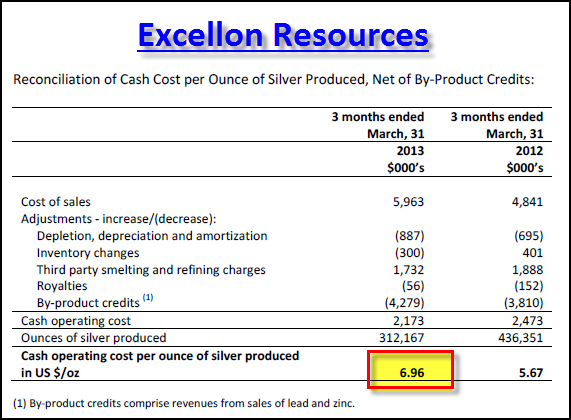
 According to Excellon, they produced silver at a cash cost of $6.96
an ounce in Q1 2013, up from $5.67 in the same period in 2012. As you
can see they took their cost of sales ($5,963,000) and
then added back Depletion, depreciation, amortization, inventory changes
and by-product credits. Thus, they had a cash operating cost of only $2,173,000 which was divided by silver ounces produced (312,167 oz) to get their $6.96 cash cost.
According to Excellon, they produced silver at a cash cost of $6.96
an ounce in Q1 2013, up from $5.67 in the same period in 2012. As you
can see they took their cost of sales ($5,963,000) and
then added back Depletion, depreciation, amortization, inventory changes
and by-product credits. Thus, they had a cash operating cost of only $2,173,000 which was divided by silver ounces produced (312,167 oz) to get their $6.96 cash cost.
With this sort of low cash cost structure, Excellon should be making excellent profits. However, if we look at their Financial Statement for Q1 2013 we have the following:
 Even, with such a low cash cost of $6.96 an ounce, Excellon stated a $601,000 net income loss for Q1, 2013 compared
to a $5.6 million net gain in previous period. If we went by
Excellon’s change in cash cost year over year, this would be the result:
Even, with such a low cash cost of $6.96 an ounce, Excellon stated a $601,000 net income loss for Q1, 2013 compared
to a $5.6 million net gain in previous period. If we went by
Excellon’s change in cash cost year over year, this would be the result:
First… we will notice, that revenues on the top of the table declined more than $3 million. That alone wipes off $3 million from their bottom line.
Second…. their Cost of Sales increased from $4.8 million to $5.9 million, year over year. So, that knocks off another $1+ million of net income.
Third… if we look at their exploration cost (in blue), we will see that it increased nearly $2.8 million compared to the same quarter last year. That erases at least another $2.5 million from their bottom line.
Without those three factors, Excellon would have shown a positive $6.5 million net income gain instead of a loss. As you can see, Excellon’s cash cost of $6.96 does not provide the investor a clue to the profitability of the company.
If you look at the table below there are TWO BIG Culprits that destroyed Excellon’s profitability compared to the same quarter a year ago.
 The first big problem was the decline in silver grade year over
year. At the top of the table you can see that the average ore grade
in Q1 2013 was 591 g/t (grams/tonne) compared to 949 g/t, Q1 2012. Not
only did Excellon suffer a 38% decline in grade, the also processed an
addition 1,250 tonnes of ore. Here we can see that Excellon had higher
costs to produce 125,000 less ounces of silver.
The first big problem was the decline in silver grade year over
year. At the top of the table you can see that the average ore grade
in Q1 2013 was 591 g/t (grams/tonne) compared to 949 g/t, Q1 2012. Not
only did Excellon suffer a 38% decline in grade, the also processed an
addition 1,250 tonnes of ore. Here we can see that Excellon had higher
costs to produce 125,000 less ounces of silver.
The next big hit came from their $6.30 decline in the price of silver they received shown at the bottom of the table. I highlighted the green areas to show the zinc and lead by-product data. We can see that zinc and lead were not part of the problem in profitability as the price of lead was the same while zinc fell half of what silver did.
Furthermore, both lead and zinc had higher production and sales. The practice of mining companies subtracting their by-product credits from their silver mining costs to show a LOW CASH COST obfuscates the TRUE BOTTOM LINE PICTURE.
Total costs to mine silver are much higher than the industry is putting out in their financial statements. With the current low price of silver below $22, the majority of primary silver producers are losing a great deal of money. According to my calculations of my top 12 silver miners only ONE is making a little money.
Even though the mining stocks have declined substantially over the past few years, once the broader stock markets collapse, money will be forced to move into hold physical assets to protect their wealth. The mining stocks may turn out to be some of the best assets to own in the next several years.
http://srsroccoreport.com
It doesn’t matter which mining company report you look at, just about all of them list what their cash cost is to produce their main metal. Furthermore, the Silver Institute lists the primary silver miner’s cash cost per ounce from the Annual World Silver Survey on its website for all to see.
According to the Silver Institute:
Primary silver mine supply grew by 1 percent to account for 28 percent of global silver mine output. Mexico was the world’s largest silver producing country in 2012, followed by China, Peru, Australia and Russia. Primary silver mine cash costs rose to $8.88 an ounce, reflecting higher prices for labor, electricity, and maintenance charges.So, it seems as if the primary miners produced silver at $8.88 cash cost an ounce in 2012. This was up over 2011. Here are the cash cost figures for the past 3 years (World Silver Survey’s, Silver Institute & Kitco):
2010 = $5.47 (avg. spot price = $20.19)With low cash costs such as these, the silver miners should be raking in the dough and stating huge profits. However, a percentage of these primary silver miners are actually stating net income loses even at realized prices of $28-30 an ounce.
2011 = $8.11 (avg. spot price = $35.12
2012 = $8.88 (avg. spot price = $31.15)
When the World Silver Survey calculates the primary silver miner’s cash cost, they only use a sample portion. Let’s just say, this sample size is less than two-thirds of the silver produced from the primary miners. Even though the folks (GFMS, Reuters) who publish the World Silver Survey do a good job calculating the cash cost for the primary silver mining industry, we will find out how useless it can be in determining the profitability of a mining company.
Excellon Resources Very Low Cash Cost & Net Income Loss??
I selected Excellon Resources as they are a perfect example to show how a company can state a very low silver cash cost while reporting a net income loss. Now, I am not singling out Excellon or putting out negative information about the company, rather Excellon is actually a pretty good company that has the highest grade silver mine in Mexico.Let’s take a look at Excellon Resource’s Q1 2013 report on their cash cost:
With this sort of low cash cost structure, Excellon should be making excellent profits. However, if we look at their Financial Statement for Q1 2013 we have the following:
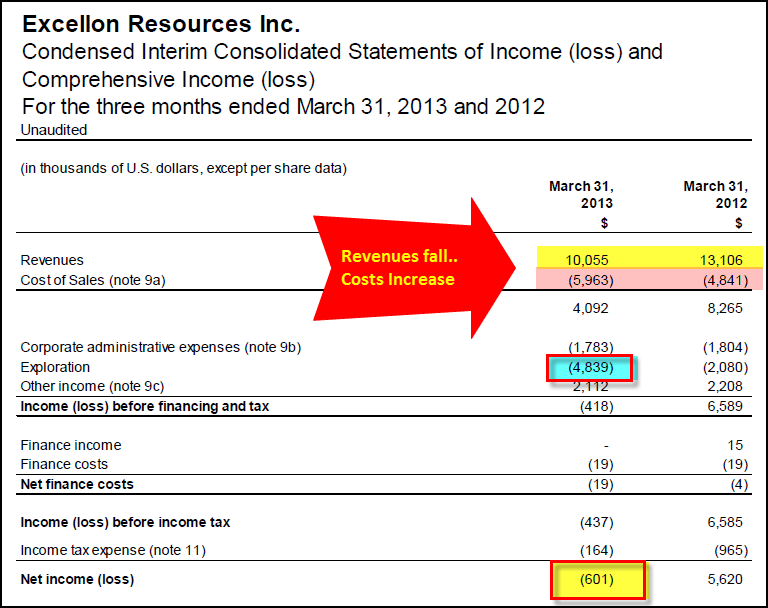
CASH COST Change: $6.96 – $5.67 = +$1.29 ozSomething seems fishy. How could Excellon’s cash cost increase only $1.29, but their net income decline more than $6 million year over year?
First… we will notice, that revenues on the top of the table declined more than $3 million. That alone wipes off $3 million from their bottom line.
Second…. their Cost of Sales increased from $4.8 million to $5.9 million, year over year. So, that knocks off another $1+ million of net income.
Third… if we look at their exploration cost (in blue), we will see that it increased nearly $2.8 million compared to the same quarter last year. That erases at least another $2.5 million from their bottom line.
Without those three factors, Excellon would have shown a positive $6.5 million net income gain instead of a loss. As you can see, Excellon’s cash cost of $6.96 does not provide the investor a clue to the profitability of the company.
The Cash Cost Disclaimer
Anytime a company reports their cash cost in their financial reports they include the following explanation (I label it as a cash cost disclaimer) of their cash cost. This one is from Excellon’s Q1 2013 MD & A Report:Cash operating cost, net of by-product credits, is provided as additional information as is non-IFRS measure that does not have a standardized meaning. This measure should not be considered in isolation or as a substitute for measures of performance prepared in accordance with generally accepted accounting principles and is not necessarily indicative of operating expenses as determined under generally accepted accounting principles.IFRS stands for International Financial Reporting Standards and GAAP is the generally accepting accounting principles. Basically, cash costs are not indicative of operating expenses and are not in accordance with either the IFRS & GAAP.
What Caused Excellon to Lose Revenues & Profits?
So now that we know Cash Costs are bogus in determining the profitability of a company, let’s look at what happened to Excellon’s balance sheet.If you look at the table below there are TWO BIG Culprits that destroyed Excellon’s profitability compared to the same quarter a year ago.
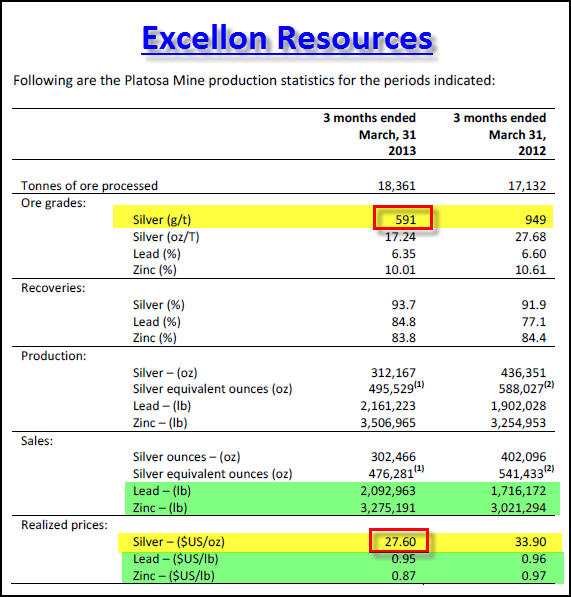
The next big hit came from their $6.30 decline in the price of silver they received shown at the bottom of the table. I highlighted the green areas to show the zinc and lead by-product data. We can see that zinc and lead were not part of the problem in profitability as the price of lead was the same while zinc fell half of what silver did.
Furthermore, both lead and zinc had higher production and sales. The practice of mining companies subtracting their by-product credits from their silver mining costs to show a LOW CASH COST obfuscates the TRUE BOTTOM LINE PICTURE.
What was Excellon’s Estimated Silver Break-Even Price
There are several ways to get to a pretty good estimated break-even price for a silver miner. You have to use either Net Income or Adjusted income and divide it by the Silver ounce sold during the quarter. Then you add or subtract that figure to their Realized Price that quarter.-$601,000 / 302,466 = -$1.99So, we can see that Excellon needed $29.59 an ounce silver to break even that quarter. This is a very simple and easy way to get an estimated break-even, however there are other more detailed methods which will be discussed in future posts.
$27.60 + $1.99 = $29.59 Net Income Break-Even
Total costs to mine silver are much higher than the industry is putting out in their financial statements. With the current low price of silver below $22, the majority of primary silver producers are losing a great deal of money. According to my calculations of my top 12 silver miners only ONE is making a little money.
Even though the mining stocks have declined substantially over the past few years, once the broader stock markets collapse, money will be forced to move into hold physical assets to protect their wealth. The mining stocks may turn out to be some of the best assets to own in the next several years.
http://srsroccoreport.com
分析師Schiff:黃金仍有大幅上漲空間

每個人都有翻開歷史新頁的一天。對Peter Schiff而言,這天尚未到來。
今年,「黃金當然可以上漲到1700或1800美元。但我認為,最終黃金還會進一步大幅走高,」Schiff告訴CNBC電視台說。
其實,這位黃金多頭不只仍看漲,他還極度看漲。
「當世界了解我們現在所處的水平,黃金將會漲翻天,」歐元太平資本公司執行長Schiff說。
Schiff相信,聯準會(Fed)持續的貨幣寬鬆政策,將導致通貨膨脹,推升黃金走高。那麼,Fed將縮減購債計劃的傳言,是否讓他感到擔憂?
一點也不。
「Fed沒有退場策略,」Schiff說。「這只是空談。沒有縮減計劃,因為縮減購債會搞垮經濟,銀行業,還有美國政府。」
他補充說,「Fed可能會進一步推出量化寬鬆(QE),他們將必須印更多鈔票,買更多公債,阻止市場崩跌,這對黃金極屬利多。」
那麼,短期看法如何?Schiff承認,黃金走勢並不佳,但他相信黃金是在打底。
「的確有許多投機客軋平技術性黃金倉位。有許多技術性賣壓,黃金市場的氣氛非常利空,投資人因而趁漲勢賣出,」Schiff說。「但底部就是因此出現。」
一旦黃金築底完成,高點就在天上了。
「當黃金市場反轉,就會劇烈,」Schiff說。「我認為黃金將會上漲,而且速度會比下跌還快。」
訂閱:
文章 (Atom)