Currently China holds (or more accurately, is believed to hold) $3.66T in foreign reserves – assumed to be primarily in US Treasuries.
While the total comes from PBOC, the composition of the assets held is
speculative. There is also, of course, the ever-popular 1,054.1 metric
tons of Chinese gold reserve:
“
China hasn’t announced any changes to state gold reserves since
authorities in 2009 said bullion holdings totaled 1,054.1 metric tons.” — though
the Bloomberg article does grudgingly acknowledge that there ‘may be some discrepancy’ between the reported end-2008 figure and current reality…
So, what’s up? Is
China content to ride the status quo, keep buying foreign currencies to
keep the yuan down? Is it moving to advance the cause of the SDR by
pushing for inclusion in it, along with Russia? What, if anything do the
above have to do with the build-out of Chinese gold production
capability, and in-country reserves?
1. How much non-China-based gold reserves/deposits does China control?
2. What is the rate of production of the COMBINED Chinese-controlled gold mining operations worldwide?
The data sources I stumbled upon
present a remarkable sketch of the lengths China is going to in order to
secure resources around the world.
From JY896, TFMetalsReport:
As I started digging further, I came up against what any average
investor faces on a daily basis – it is extremely difficult to find
specific, current, reliable information that is presented in just the
way one is seeking it. If it HAPPENS to be available, it is an expensive
report to acquire. The questions I was seeking answers for:
- How much non-China-based gold reserves/deposits does China control?
- What is the rate of production of the COMBINED Chinese-controlled gold mining operations worldwide?
I was not able to find all of the answers, but will try to share the
breadcrumb trail that I eventually traced, and the data sources I
stumbled upon. They present (what was to me) a remarkable sketch of the
lengths China is going to in order to secure resources around the world.
Here’s a
Forbes/Kitco article where Jim Rickards and our very own house favorite Jeffrey Christian agree on something:
“What the Chinese want is to have the Yuan in the SDR
basket but not open up their capital account,” he said. “That is a
backdoor way for the Yuan to be a de facto reserve currency without
having to give up control.” – Rickards


They BOTH insist that:
“The two analysts also agree that expectations the Yuan will become a reserve currency on its own are extremely overblown.”
What is brilliant about THIS particular Forbes article is that it
presents quite enough half-truths to completely confuse and mislead
interested investors, WITHOUT being a flat-out lie.
“Rickards said he thinks China has not updated its
reserves because they continue to buy gold. He said China has a pattern
announcing their reserves every six years, after the bank has reached
its target. […] On the contrary, Christian said that he suspects that
one of the reasons why the bank hasn’t updated its reserves is because
it’s not buying that much gold or as much gold as people expect.”
BRILLIANT!
OK, onto another option: China is working in conjunction with the
other BRICS nations and to a degree with the Eurozone to construct the
fabled gold-based trade settlement system that the Jackass is always
going on about? One of the indicators, the extensive and growing network
of yuan-based trade settlement swaps with nearly all major Chinese
trading partners is well established. The other indicator of massive
gold inflows into China has also been
thoroughly documented.

But what I was really interested in stems from this table
from the USGS (reserves being deposits in ground):
|
Mine production |
|
|
|
2011
|
2012 (est.)
|
2013 (est.)
|
Reserves |
| United States |
234
|
230
|
|
3,000
|
| Australia |
258
|
250
|
|
7,400
|
| Brazil |
62
|
56
|
|
2,600
|
| Canada |
97
|
102
|
|
920
|
| Chile |
45
|
45
|
|
3,900
|
| China |
362
|
370
|
400+
|
1,900
|
| Ghana |
80
|
89
|
|
1,600
|
| Indonesia |
96
|
95
|
|
3,000
|
| Mexico |
84
|
87
|
|
1,400
|
| Papua New Guinea |
66
|
60
|
|
1,200
|
| Peru |
164
|
165
|
|
2,200
|
| Russia |
200
|
205
|
|
5,000
|
| South Africa |
181
|
170
|
|
6,000
|
| Uzbekistan |
91
|
90
|
|
1,700
|
| Other countries |
640
|
645
|
|
10,000
|
| World total (rounded) |
2,660
|
2,700
|
|
52,000
|
Note that China is the largest producer of gold in the world (has
been for 7 years running now – estimated in italics my addition from
reports below) —
but at current rate set to exhaust its reserves in 4-5 years.
Some other good starting points:
PriceWaterhouseCoopers has a global
Gold Price Report, and Thomson Reuters GFMS publishes an annual report (I am not sure they meant to share it, but
here it is: Gold Survey 2013). The former is compiled from a survey of gold mining companies, and has the following passage:
“China is keen on gold for two main reasons:
- The life of mine for China’s gold mines is low. To ensure they
have secure access to gold in the future China is looking at promising
gold acquisitions abroad.
- The Chinese Central Bank has increased its gold held. Thus, it
is expected to support state-owned entities acquiring additional gold
assets both in China and abroad.”
- [What is left out, of course, is any reference to any
possible upcoming fundamental shift in the role of gold in Chinese
monetary policy.]
The report has interesting, if anecdotal, examples of Chinese mining expansion, and both gold and silver data.
The other,
GFMS report
is more comprehensive, tackling everything from cost of production,
composition and direction of imports/exports from major producing
regions, GOFO and much more. Definitely worth a look. It includes this
table:
| TOP |
20
|
GOLD |
MINING |
COUNTRIES |
|
Production |
(t) |
Change |
|
|
|
2011
|
2012
|
12.H1 |
13.H1 |
y-o-y |
| China |
371.0
|
413.1
|
182.1
|
197.8
|
9%
|
| Australia |
258.6
|
251.4
|
124.8
|
126.9
|
2%
|
| United States |
233.0
|
231.3
|
112.3
|
110.1
|
-2%
|
| Russia |
215.6
|
230.1
|
89.5
|
96.3
|
8%
|
| South Africa |
202.0
|
177.3
|
93.4
|
87.4
|
-6%
|
| Peru |
187.6
|
180.4
|
92.8
|
84.4
|
-9%
|
| Canada |
107.8
|
108.0
|
51.1
|
60.9
|
19%
|
| Ghana |
91.0
|
95.8
|
54.3
|
51.9
|
-4%
|
| Mexico |
88.6
|
102.8
|
52.3
|
49.6
|
-5%
|
| Indonesia |
120.1
|
89.0
|
45.8
|
42.6
|
-7%
|
| Uzbekistan |
71.4
|
73.3
|
35.9
|
39.2
|
9%
|
| Brazil |
67.3
|
67.3
|
32.3
|
36.4
|
13%
|
| Papua New Guinea |
63.5
|
57.2
|
28.8
|
31.0
|
8%
|
| Chile |
44.5
|
48.6
|
23.0
|
25.4
|
10%
|
| Argentina |
59.1
|
54.6
|
26.7
|
24.5
|
-8%
|
| Mali |
43.5
|
50.3
|
24.2
|
23.9
|
-1%
|
| Tanzania |
49.6
|
49.1
|
24.6
|
21.2
|
-14%
|
| Kazakhstan |
36.7
|
40.0
|
18.6
|
21.1
|
14%
|
| Philippines |
37.1
|
41.1
|
20.4
|
20.1
|
-1%
|
| Colombia |
37.5
|
39.1
|
19.6
|
20.1
|
2%
|
| Rest of World |
453.8
|
464.3
|
222.0
|
244.7
|
10%
|
| World |
2,839.10
|
2,864.00
|
1,374.40
|
1,415.60
|
3%
|
| Source: |
Thomson |
Reuters |
GFMS |
|
|
It has another, completely unintentionally hilarious table on page 5
of the report, which is an apt illustration of the absurdity of our
circumstance: between 2012 and 2013, global supply and demand each
expanded by 1.6% (nevermind the doubt that might arise from how the
components are calculated) – but during the same period gold price
dropped by 13.4% in USD/oz terms. Yeah, and these are open and fairly
traded markets, and the USD has gained over 13% in purchasing power in
the last year.
But returning to our story – take a moment to go back up and compare these lists of gold-producing countries with the map below.
There is this interesting little infographic from Stratfor (along with a brief report on the topic of
China and African investments) — open in new tab for full size:
 “Chinese Investment in Africa is republished with permission of Stratfor.”
There appears to be strategic, long-term and quite extensive project underway for the ‘benevolent colonization’ of Africa – and
wherever else has resources:
“Meanwhile, trade data shows that just three
commodities – iron ore, oil and soy – and their derivatives – still
account for 80 percent of Brazil’s exports to China. […]
Derek Scissors, an expert on Chinese outward investment at the
American Enterprise Institute, a Washington think tank, said the sudden
spurt in investment, followed by a backlash and then a withdrawal, was
“absolutely classic Chinese behavior” that also occurred in sub-Saharan
Africa in recent years.
“What happens,” Scissors said, “is you start getting people
saying ‘Wait a minute, we are running a huge trade deficit with China.
They are investing $20 billion and grabbing up all our resources. Are we
a colony?’” – Reuters
Wherever one turns, it seems like Chinese corporations are trying to
buy resources, some of more interest to us here than others:
“China National Gold Group Corp. is considering
investing in mines owned by Robert Friedland’s Ivanhoe Mines Ltd.,
including the Platreef project in South Africa, a person with knowledge
of the situation said. […]
State-owned China National Gold has also looked at other Ivanhoe
projects located in the Democratic Republic of Congo and Gabon, though
prefers more developed countries like South Africa, the person said. No
terms for a purchase of Platreef have been finalized, and China National
Gold could instead consider buying a stake in Vancouver-based Ivanhoe
itself, the person said.” – Vancouver Sun
Australia also happens to have a relatively low population density as a country, and lots of resources:
“Australia’s business-friendly conditions make it a
priority for Chinese outward direct investment, according to a recent
HSBC survey. The survey reveals a large proportion of Chinese companies
are expanding offshore into the manufacturing and retail trade sectors –
rather than mining as expected; and are prioritising markets like
Australia that have favourable business and political conditions.
These insights are drawn from a survey by HSBC1 based on responses
from more than 250 Chinese companies that have built or are considering
building a presence overseas. Amongst those surveyed, 17% were large
conglomerates with the remainder being of a corporate or middle market
size.” — our very good friends at HSBC
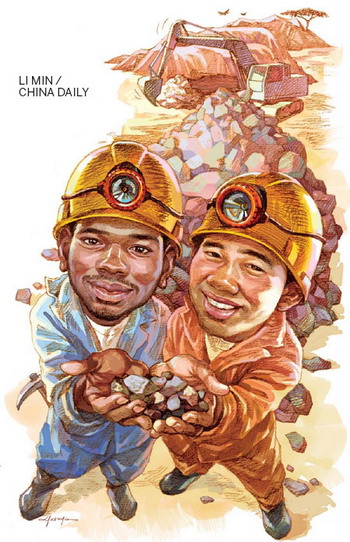
The Chinese media like to portray it thus (there are some who say not all parties involved agree with the depiction):

There is a crucial paragraph from the article that struck me:
“People don’t understand the mathematical mechanics
of compound interest. China’s growth might have slowed slightly but the
base is huge. Last year China added another Australia to its GDP, by
2018 this will be another Germany and by 2021, another Japan and that
will be every year. The volume demand for resources will not decline,”
he says.” – People’s Daily
Is it possible the Chinese have finally truly mastered this
understanding of the exponential function? Could it be they are
preparing for the next “
doubling of the bacteria in the soda bottle”? Are the ghost cities in China and elsewhere (Angola) truly follies of central planning and an overflow of excess capacity?


Or do they represent a decades-spanning plan to increase Chinese
Lebensraum?
Some examples of how this is playing out across the continent (again, refer to Africa map above):
“”The Chinese have changed Zambia,” said Nelson
Mwendabai, a retired civil servant who ticked off Chinese-backed
projects: a railway between Tanzania and Zambia, new roads, schools,
clinics and stadiums. Mwendabai said: “We should just accept that they
are our friends.”
Zambian President Michael Sata criticized the Chinese presence as
an opposition leader, seeking to harness nationalist unhappiness with
Chinese accused of taking jobs from Zambians by engaging in low-pay jobs
such as pushing wheelbarrows at construction sites. He changed his tune
after his Patriotic Front party won elections in 2011. In April, Sata
went to China on an 11-day state visit, soon after new Chinese ruler Xi
Jinping took office.
“I have come to say ‘thank you’ for the work the Chinese are doing in Zambia,” Sata told Xi.” – ABC News
See, campaign contributions and “other contributions” are a very strategic and lucrative investment
everywhere in the world…
“Tanzania has signed contracts worth $1.7 billion
with Chinese companies to construct power plants and housing units in
east Africa’s second-largest economy. […]Tanzania signed a framework
agreement in May with China Merchants Holdings (International) Co Ltd
for the construction of a new port, special economic zone and railway
network that could involve more than $10 billion.
China, which built a railway linking Tanzania and Zambia in the
1960s and 1970s, is also financing a $1.2 billion 532-km (330-mile)
natural gas pipeline from the south east of the country to the
commercial capital Dar es Salaam.
In 2011 China’s Sichuan Hongda Co. Ltd signed a $3 billion deal with Tanzania to mine coal and iron ore.
Chinese companies are also eyeing Tanzania’s natural gas reserves
and are expected to bid for oil and gas blocks in the country,
according to the African country’s energy ministry.” — Reuters
It has come to a point where Chinese gold prospectors are swarming African goldfields in a 19
th- century-like gold rush:
“Ghana has been inundated with migrant gold miners in
recent years and the vast majority — an estimated 50,000 — are Chinese
from Shanglin county. The Chinese miners claim they were operating in
legal partnership with local Ghanaian landowners (although many admit to
not having valid documentation). Hundreds of miners, including Yang,
were rounded up and deported a couple of weeks ago.” — TIME
There is a reasonably well-rounded landscape report from the
Economist here – while dated, it contains a nice quote from W.H. Auden (no, I had no idea who that was, either*):
“I’ll love you, dear, I’ll love you
Till China and Africa meet,
And the river jumps over the mountain
And the salmon sing in the street.”
Apparently, hell has frozen over and W.H. Auden has now left his paramour.
* –
http://en.m.wikipedia.org/wiki/W._H._Auden
In an interview on
Bullionvault, Matt Badiali of Stansberry & Associates gives the following, in my opinion very astute, summary of China’s approach:
“We have been watching China’s investments in Africa
for a while now. China is spending billions of Dollars in Africa in very
specific ways: financing power plants, building railroads and
developing other infrastructure plays.
Why? If you want to build a mine, you need electric power. You need to be able to get ore from the mine to a port. China is laying the groundwork for mine development all over Africa.
Look also at what China is buying: one of the world’s largest
undeveloped uranium deposits, bullion and shares in African gold miners,
from major mining companies to partnerships with juniors and
exploration projects.
At the Mines and Money Conference in Hong Kong, I asked
representatives of major Chinese investment banks and funds if gold is a
major target for Chinese investment in Africa. Across the board, they
all said yes.”
It’s not JUST gold, you understand – from building solar plants in
Chile, to becoming the primary trade partner of seemingly all
resource-rich countries developing/developed alike, China has been
busily weaving its web. The game afoot is on larger scale and for larger
stakes than most people seem to realize:
“an estimated 259,000 Chinese nationals in Angola are
mainly construction workers helping to rebuild the country after a
devastating 27-year civil war that ruined much of its infrastructure” – Ghanaweb (also an interesting, longer article on Chinese involvement in Ghana)
When an economy can just point, and send nearly 300K workers to the
middle of Africa in the space of a few years, one has to wonder a bit as
to whether their planning and execution is really as flawed as Western
analysts are often prone to thinking. The millions of empty
apartments/offices built in the ghost cities COULD be an example of the
irrational excesses of
central planning gone wrong.
But even if they WERE, they could now become outposts, forts on hills,
trading posts in native country. Inside China, they could be meant to
support the continued migration of rural workers to the cities (or
massive in-migration of population from elsewhere?), in places like
Angola they can serve as stakes in the ground. A more optimistic
viewpoint might be the expectation of the Chinese planners that in the
future, raw materials and resources will become significantly more
valuable, creating the jobs and thus income necessary for large masses
of people to move to such environments. And if you have 300K citizens in
another country, are you not then bound to ensure the safety and
security of that expatriate community, at some point – with all the
options available to a nascent global power?
While
building a megapolis
in the middle of Inner Mongolia (think Nevada, only the desert is much
bigger) might seem eccentric, look at these pictures and tell me this
was done as a budget-consuming, megalomaniacal, insane scheme of a few
local party officials desperate to generate tangible growth, no matter
the irrationality (courtesy of TIME photographer Michael C. Brown, see
link above):


As another photo essay (regrettably of lower resolution, but more extensive in pictures) on ghost cities notes:
“China wants to move more than 400 million people from the countryside to the city in the next 10 years. […] “social engineering on the grandest of scales.” ” – Business Insider
So, what’s the take-away here? That “the Chinese are coming” is
something everyone should have realized by now – their speed and impact
is what is in question. My view is that insofar as they are able to pull
off a social transformation and internal development akin to what has
already been demonstrated several times (with tragic side-effects, alas)
in the history of central planning from Lenin onward, they are in fact
positioning themselves to be able to vault to a position of true global
leadership in a relatively
rapid timeframe. Whether or not they
are waiting for (or waiting to initiate) any global monetary reset, it
could be argued that they are certainly PREPARING FOR it. While we all
(should) know the officially maintained figure of ~1000 ton gold reserve
on record for China is bogus, how much really IS in China proper, or in
‘deep storage’ (aka minable deposits) under direct or indirect Chinese
control today? With production in China itself making up 14.4% of the
global supply in 2012, what is the
true figure today – and what is it when including the amounts shipped back from territories further afield?
I didn’t have a chance to fully get the answers to all of these
questions, but I’m hoping there are some among you who can round out the
tale. But I would say, we will be getting used to images like these —
not just in Africa:


I have been left with the impression that, given the opportunity and
the right set of conditions (which the Chinese leadership seems very
diligent in working to bring about), this setup will allow China to turn
on afterburners and switch its (now more distributed) economy to even
higher gear at a ‘moment’s notice’ (relatively speaking). And of course,
that there seems to be zero confusion on the part of China and her
people (as a whole) on what represents wealth and real money.
As always, keep stacking.

Appendix:
Eye-candy on the above topics:
Infographic on Global Gold Mines and Deposits Ranking 2012 from Visual Capitalist
Infographic on the evolution of modern Chinese relationship with gold (ZH blurb here, original from The Real Asset Co. here)
Some resources for silver (forgive the Silver Institute links – sometimes the gatekeepers can have useful data):
Global silver supply/demand tables
World Silver Survey 2013: A Summary produced for The Silver Institute by Thomson Reuters GFMS
The Chinese Silver Market (produced for The Silver Institute by Thomson Reuters GFMS)
In searching for illustrations for this post, I started out by looking for images from Looper (
worth a look
if you are a fan of time-travel sci-fi and/or are a diehard Bruce
Willis fan – hitmen in the future get paid with silver & gold bars
from an even more distant future). It turned out I couldn’t find one of
the protagonist’s floor safe filled with silver bars so these will have
to do:
 http://www.silverdoctors.com/